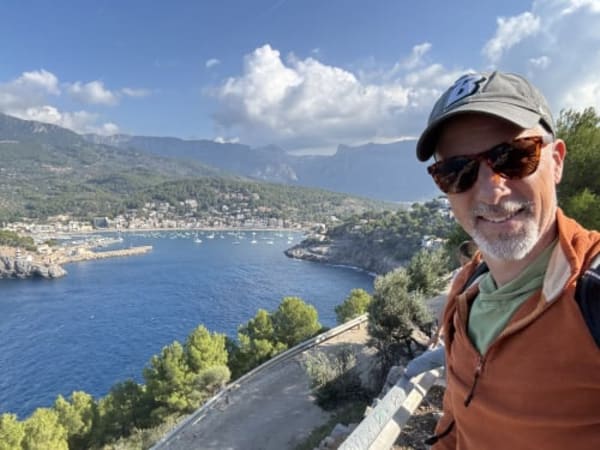

We Rented a Cave House in Imerovigli — Here's What That Actually Means
The Short Version
- Imerovigli sits at approximately 300 meters above the Aegean — higher than Oia — giving it arguably the best caldera sunset views on the island with a fraction of the crowd.
- The cave houses have a name, yposkafa, meaning 'dug into the rock,' and were originally carved out of the volcanic cliff by sailors who couldn't afford the neoclassical mansions their ship captains built above them.
- Barrel-vault ceilings weren't an aesthetic choice: the curved shape distributes seismic pressure evenly through the rock, which is why many cave houses survived earthquakes that destroyed conventional buildings around them.
- After a 7.5-magnitude earthquake in 1956 destroyed 529 homes across Santorini, the abandoned cave ruins sat empty for years — then tourism arrived and flipped their status entirely from the island's poorest housing to its most sought-after.
- Rolling suitcases are a genuine mistake here — the cobbled, steeply pitched paths will destroy wheels fast, and most cave houses are accessed down staircases below street level, so a soft-sided bag is worth the pre-trip repack.
The Moment We Realized We'd Made the Right Call

The Moment We Realized We'd Made the Right Call
We had been in Santorini for about four hours when we opened a bottle of something cold and carried it up to the terrace. The sun was dropping toward the caldera. The white buildings of Oia were stacked on the cliff across the water, catching the last light. Someone handed me a champagne glass and I just stood there for a moment, not taking the photo, not doing anything useful.
That is the moment I keep coming back to. Not the flight, not the transfer, not the navigation through narrow paths with luggage that barely fit. Just that first evening on a small rooftop in Imerovigli, watching the Aegean go gold.
We had rented a cave house — a real one, carved into the volcanic cliff, not a hotel suite with cave-style décor. For five nights, this was home: vaulted ceilings, arched doorways, built-in sleeping platforms carved from the same rock the island is made of. It looked like the inside of something organic. It felt like it too.
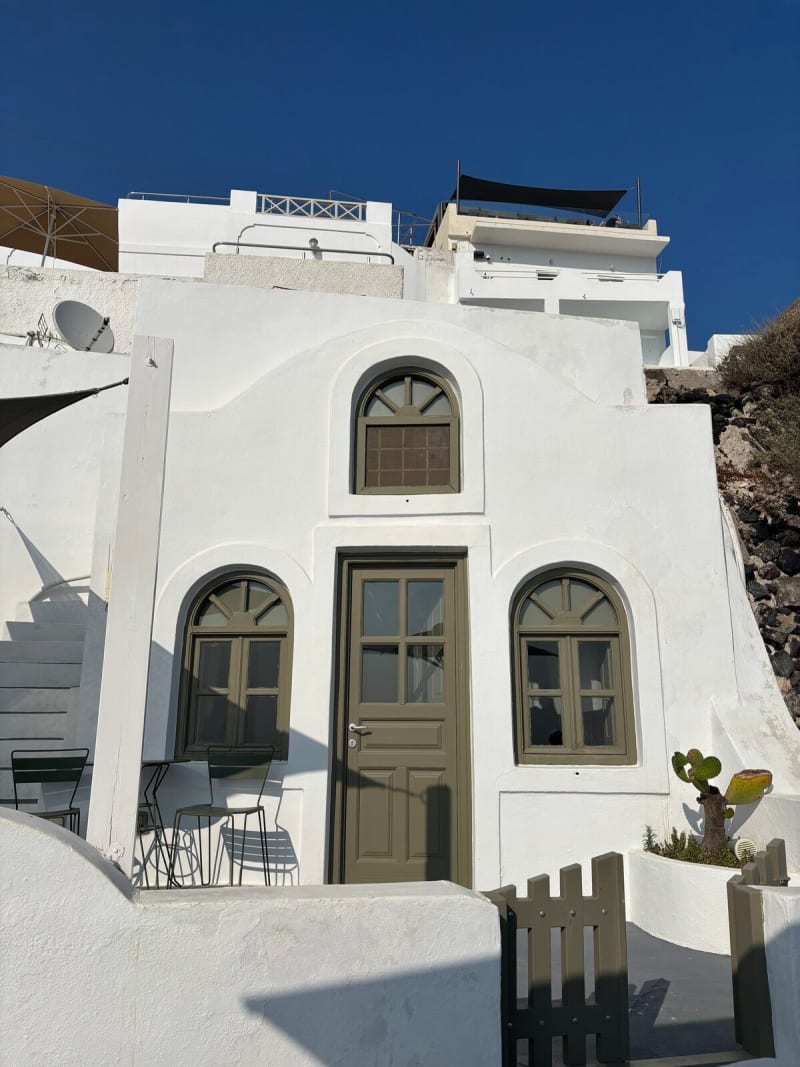
What does it actually mean to sleep inside a Santorini cave house? Most articles will tell you it's magical and leave it there. This one won't. There is genuine history behind these walls, a specific reason the rooms are shaped the way they are, and a sensory experience that is harder to describe than it looks in photos. We stayed long enough to understand most of it.
Imerovigli: The Village Most People Drive Through
Imerovigli: The Village Most People Drive Through
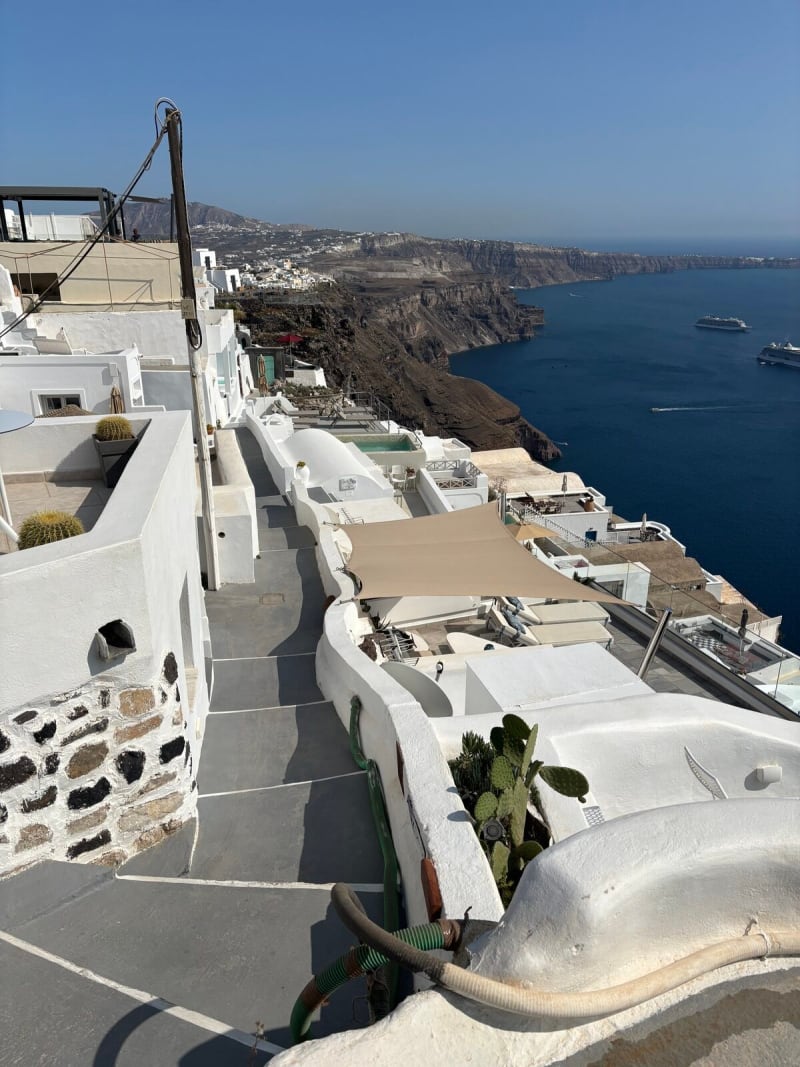
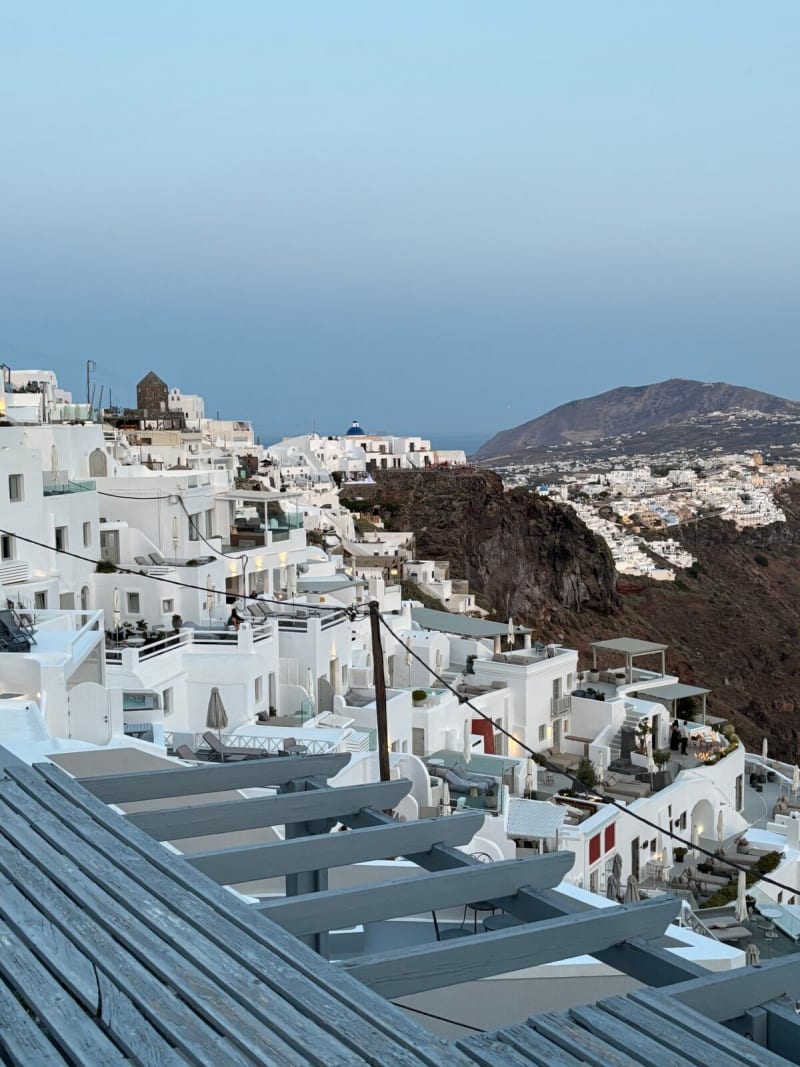
Imerovigli sits at the highest point on the caldera rim — approximately 300 meters above the Aegean — and most visitors to Santorini pass through it on the way between Fira and Oia without stopping. That is either their loss or their gift to the people who do stop, depending on how you feel about crowds.
The village is 3 kilometers north of Fira and is known locally as the Balcony of the Aegean, a name that earns its keep every single evening when the sun drops toward Thirassia Island and the whole caldera turns the color of something you cannot name. The views here are, by most accounts, better than Oia's. You are higher, facing directly west, with nothing between you and the horizon.

Below the village, Skaros Rock juts dramatically into the caldera — a volcanic promontory that was once the capital of the entire island. A Venetian fortress was completed here in 1207 by the architect Giacomo Barozzi, and at its peak the settlement housed over 200 homes within its stone walls. It was never conquered. It simply eroded — a 1650 eruption collapsed part of it into the sea, and the last residents abandoned it for Fira and Imerovigli sometime in the 18th century. What remains today is a rock formation and a hike worth taking, the ruins of something that used to be the most important defensive position in the Cyclades.

Imerovigli is also a registered traditional settlement, which means building regulations require structures to follow specific architectural guidelines. No accidental modernization. No glass towers. The whitewashed walls, the domed profiles, the cave-cut facades — all of it is protected. Tourism here developed seriously only from the early 1990s, late by Santorini standards, and the village has stayed quieter than its neighbors by both regulation and temperament.
The paths are narrow. There are stairs everywhere. A rolling suitcase is nearly useless. Welcome.
Inside a Real Santorini Cave House

Inside a Real Santorini Cave House
The houses have a name: yposkafa — a Greek word meaning, literally, dug into the rock. They were not designed by architects working from drawings. They were carved out of the caldera cliff by sailors who could not afford anything else.
In the 18th and 19th centuries, Santorini was a major Mediterranean shipping hub. A fleet of roughly 130 sailing vessels worked out of the wharf at Armeni Bay beneath Oia. The wealthy ship captains built two-story neoclassical mansions on top of the caldera rim. Their crew members dug down into it. The yposkafa were the smallest homes on the island — a single oblong room, a narrow facade, light entering through the front door and two small windows. The cooking area was outside. The toilet was outside. Water came from a stone cistern that caught rainwater from the courtyard, because Santorini has almost no natural freshwater.
What those sailors could not have known was that they had stumbled onto one of the most structurally intelligent building techniques in the Aegean. The volcanic tuff they carved into — a porous pumice-based rock — is a poor conductor of both heat and sound. The barrel-vault ceilings that define every cave house interior were not an aesthetic choice: the curved shape distributes seismic pressure evenly through the rock, which is why many cave houses survived earthquakes that destroyed conventional buildings above them. The Theraic earth plaster, mixed with limestone from Profitis Elias mountain, hardened with humidity over time, becoming stronger as the structure aged.

The layout of our rental made all of this visible. The main room opened from the street facade — arched windows, the widest part of the space, most of the natural light. The rooms moved progressively deeper and darker and cooler: living area, then kitchen and dining, then sleeping nooks built directly into the rock, then the bedroom at the back, which at midday felt like a different climate from the terrace. The sleeping platforms and alcoves our kids immediately occupied were not designer furniture. They were the original carved forms, resurfaced and cushioned but structurally the same as what the sailors slept in.

After the devastating 1956 earthquake — a 7.5-magnitude event that destroyed 529 homes and damaged over 3,000 more across Santorini, including heavy damage to Imerovigli itself, most of the surviving cave house ruins sat abandoned for years. When tourism arrived in the 1970s and 80s, Greek architects and entrepreneurs started looking at these empty carved-out spaces differently. What had been the poorest housing on the island became the most atmospheric. That inversion is now complete: staying in a cave house is today a marker of the higher-end Santorini experience. The sailors who carved these rooms would find that completely baffling.

What does it actually look like to live inside one? More space than you expect, once you stop expecting hotel-room logic. The rooms are deep and layered. The arches create zones without walls. The loft sleeping area, reached by steep whitewashed stairs, felt like something a kid would design if you gave them a volcanic cliff and told them to build a bedroom.

The Terrace Changes Everything

The Terrace Changes Everything
There is the cave, and then there is everything the cave looks out onto.
The terrace of our Imerovigli rental faced the caldera directly — the full arc of the volcanic crater, the dark blue of the Aegean, Nea Kameni island in the center distance, ferries crossing between them like slow punctuation. On a clear morning, which every morning was, the caldera looks almost designed. Too composed, too blue, too precisely framed by white walls and the edge of the cliff. It takes a day or two before you stop noticing it in a state of mild disbelief.
We had breakfast there every morning. Coffee, whatever we had bought at the small market up the path, the sun coming from the east and the volcano to the west still in cool shadow. There was nowhere better to be at seven in the morning anywhere we have ever been.
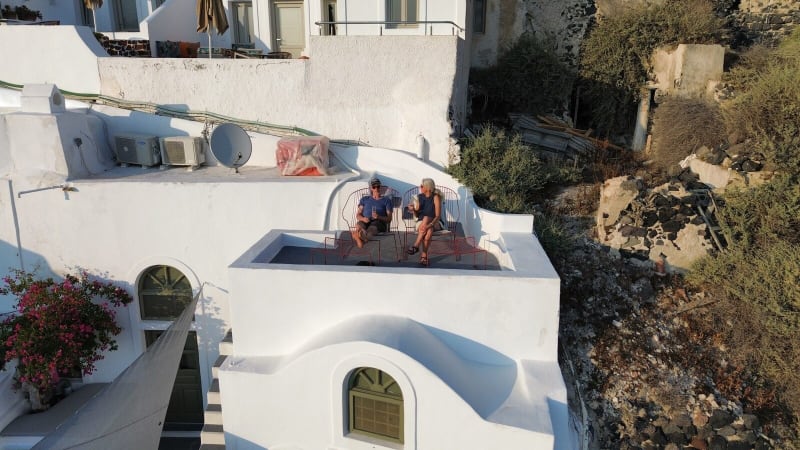
The evenings were the other side of that same coin. Imerovigli faces due west, and the sunset here is not something you fight a crowd to see. You watch it from your terrace, or from the edge of the caldera path, with a glass of whatever you managed to find, and the whole village gets quietly ceremonial about it. Nobody is performing. Everyone is just watching. That quality — the quieter, more intimate atmosphere compared to Oia, which clears out at sunset into something closer to cathedral silence — is the real reason to choose Imerovigli.
The drone photograph of the two of us sitting on the rooftop terrace with wine glasses, the white walls of the village layered around us, is the single image that most accurately captures what the week felt like. Not the caldera. Not the blue domes. Two people on a small whitewashed roof, talking, at the end of an afternoon. That is the thing.
Imerovigli vs. Oia: Why We'd Choose This Every Time
Imerovigli vs. Oia: Why We'd Choose This Every Time
We spent a day in Oia. It is spectacular, and it is exactly as crowded as you have been told. By midday the main path is shoulder-to-shoulder. The sunset viewing area at the castle promontory is a competitive sport. The restaurants are excellent and also require planning weeks in advance.
None of this is a criticism. Oia is doing what it does, and it does it beautifully. But it is not where you want to sleep.
Imerovigli stays significantly quieter than either of its neighbors, particularly in the evenings. The caldera path runs directly through it, which means you can walk to Fira in about 30 minutes or to Oia in under two hours with views the entire way. You can access everything — and then come back to a village that exhales after dark.

Multiple travel writers who have stayed in both call Imerovigli the better base for caldera views — sitting higher, facing more directly west, with sightlines to both the volcano and Oia unobstructed. The sunset is arguably better here than from the Oia castle promontory, with a fraction of the audience.
There is also the specific quality of Imerovigli that is harder to quantify: it still feels like somewhere people live. Not many, and not cheaply, but the village has a small square, a few restaurants where you eat without needing a reservation, churches that have been standing since before the earthquake, paths not organized around selfie opportunities. Strict architectural preservation requirements as a declared traditional settlement have been in place long enough that there is a consistency to the place. Walking through it at night, with the caldera below and the stars beginning, you are somewhere real.
What would we give up relative to Oia? More restaurant options. More nightlife, if that matters. The famous blue domes, which are actually in Firostefani a few minutes south, and which you will photograph anyway. None of those felt like losses after day one.
What to Know Before You Book an Imerovigli Cave House

What to Know Before You Book an Imerovigli Cave House
The architecture that makes these places extraordinary also creates specific practical realities worth knowing before you arrive.
Luggage is a genuine challenge. The paths in Imerovigli are narrow, cobbled, and steep in both directions. Rolling suitcases either need to be carried or will destroy their own wheels within the first ten minutes. Cave houses are typically accessed down lanes and staircases, often below street level. A backpack or soft-sided bag is genuinely the better choice. We did not have one, and we managed, but it required two trips and some patience.
The light inside is different from what you expect. Yposkafa were designed with a narrow facade and minimal windows, so light enters from one direction and softens as it moves through the barrel-vaulted space. The rear rooms are darker and cooler. This is architecturally intentional and also why people sleep remarkably well in these houses. The volcanic pumice walls absorb sound rather than reflecting it, and the thermal mass of the surrounding rock keeps the temperature stable through the night. We would describe our sleep here as the best of the trip.
The outdoor space matters as much as the interior. Cave houses are long, deep, and narrow. The terrace or rooftop is where the light is, where the view is, where you will actually spend most of your waking hours. Make sure your rental has one that faces the caldera, and look carefully at the photos before booking — not all terraces have equal sightlines.
Privacy is real, and also relative. The rooftops of some units serve as the footpaths of others. In Imerovigli this is less pronounced than in Oia, but worth understanding. Ours faced a rocky hillside and felt genuinely private. Others might not.
Book earlier than you think you need to. The better Airbnb cave houses in Imerovigli fill far in advance for peak season. A good unit with a caldera-facing terrace, authentic architecture, and room for more than two people requires planning measured in months, not weeks.
What you will get, when you find the right one, is something no hotel room provides: the specific physical sensation of sleeping inside the thing the island is made of. The rock around you on three sides. The curved ceiling above. The cool that comes from the earth, not from a machine.
That is not a small thing. That is the whole point of coming here.
Would We Do It Again?

Would We Do It Again?
Without hesitation.
Not because everything was perfect. The walk to the grocery store involved a vertical climb that seemed to gain elevation on the way back. The luggage situation was exactly as described above. The narrow paths at night required more vigilance than we expected after a generous dinner.
But the thing about a cave house in Imerovigli is that it stays with you in a specific way. Not the postcard images, though those exist in abundance. The other things. The way the vaulted ceiling makes the room feel like it grew rather than was built. The way sound disappears inside the rock. The particular quality of late afternoon light on white plaster when the sun is coming from the west and everything the caldera touches goes the color of warm stone.
The sailors who dug these rooms out of the volcanic cliff in the 19th century were solving a housing problem. They were making do with the cheapest material available, on the least desirable slope, in houses that would have seemed like failure compared to the mansions above them. That inversion has now run its full course. What they built out of necessity is what people now cross the Aegean to sleep inside.
If Santorini is on your list, choose the cave house over the hotel. And if you have the option, choose Imerovigli over the village everyone tells you to stay in.
The terrace at sunset will explain the rest.
Content ID: XI5UHoxRafC87Xeyact2WH8J
See an error? Tell us.

Comments
Share with the Community