Can You Drink the Water in Saint-Martin? What Actually Happens — and Why
The Short Version
- Saint-Martin has zero natural freshwater — no rivers, lakes, or usable groundwater — so 100% of drinking water on the French side comes from a single seawater desalination plant at Galisbay using reverse osmosis technology.
- As of January 2024, that plant was producing roughly 8,000 cubic meters per day against demand that regularly exceeded it, and the EEASM president publicly described the facility as 'very very fragile' at the official launch of an expansion project.
- Hurricane Irma's direct hit in September 2017 buried two of three production modules under collapsed concrete, and it took until November 2 — nearly two months later — before more than 80% of homes had continuous supply restored.
- Thirty percent of produced water never reaches anyone, lost through leaks in aging pipes that a 2024 European Commission report confirmed are further degraded by the heat of tropical-climate distribution.
- During Christmas week 2024, seven workers shut down the Galisbay plant entirely for six days — peak tourist season, with gendarmerie called in — illustrating exactly what single-point-of-failure infrastructure looks like when something goes wrong.
- Orient Bay itself tested at good water quality for swimming as recently as September 2025, with E. coli and enterococcal levels well within safe ranges, even as the tap supply remains variable.
⚠️ Disclaimer
⚠️ Disclaimer
I am not a doctor, a public health official, or a water safety expert. Nothing in this article constitutes medical, health, or safety advice. Water conditions on Saint-Martin change frequently — sometimes day to day. What was true last month may not be true when you arrive. Always consult your physician before travel if you have health concerns, immune system vulnerabilities, or specific dietary restrictions. For current water quality information, contact your accommodation directly, check the EEASM (Établissement des Eaux et de l'Assainissement de Saint-Martin) website, or follow SAUR Saint-Martin's Facebook page for real-time announcements.
We've been to Saint-Martin three times now — always the French side, always Orient Beach. Every single trip, the same two questions come up when we're planning: Can we drink the water? And why does the water keep turning off?
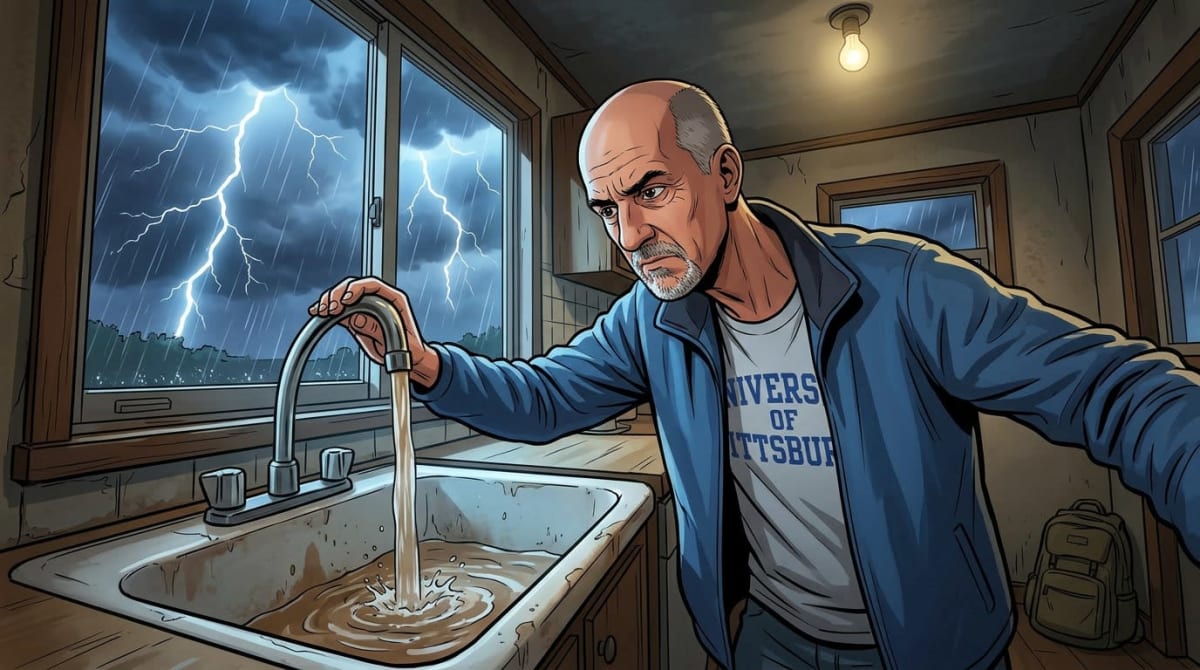
We buy our drinking water from the local grocery store. We brush our teeth with the tap. We shower in it without a second thought. We've never had an issue. But I've also sat in a rental villa watching the water pressure drop to nothing at 7 AM, stood in front of a tap that ran yellow for thirty seconds before clearing, and Googled "is Saint-Martin water safe" at midnight more than once.
After our third trip, I decided to actually research it properly — not to reassure myself, and not to scare anyone, but because the answer is genuinely interesting. The water situation on the French side of Saint-Martin is a story about geology, infrastructure, history, and the specific vulnerabilities of a small island that has no natural freshwater whatsoever. Here's what I found.
Saint-Martin Has No Natural Freshwater — None

Saint-Martin Has No Natural Freshwater — None
This is the starting point for understanding everything else. Saint-Martin — the French side, officially a French Overseas Collectivity — sits in the northeastern Caribbean and is, geologically, a dry limestone and volcanic island. There are no rivers. There are no lakes. There are no springs. According to a 2024 European Commission regional study on Saint-Martin, the island has no exploitable fresh natural resources, and the groundwater that does exist is brackish — too salty to use.
This isn't unique to Saint-Martin. Many Caribbean islands share this geology. But it means 100% of the island's drinking water comes from a single source: seawater that has been desalinated, treated, and piped to homes and hotels. When that system works, the water is fine. When it doesn't, everything stops.
That's not a metaphor. It is the literal situation.
How the Water Actually Gets to Your Tap

How the Water Actually Gets to Your Tap
On the French side, the process runs through a chain of organizations that's worth understanding — in part because when things go wrong, each link in the chain becomes a potential failure point.
The water infrastructure is owned by EEASM (Établissement des Eaux et de l'Assainissement de Saint-Martin), the public water and sanitation authority created by the Collectivity. EEASM owns the pipes, the reservoirs, and the production facilities. It delegates the actual operation — running the plant, treating the water, managing the distribution network — to a private company called SAUR, a major French water utility. SAUR operates the Galisbay desalination plant, which is the single facility that produces all drinking water for the French side of the island.
The Galisbay plant uses reverse osmosis technology. According to the U.S. Geological Survey, reverse osmosis works by forcing seawater at high pressure through semi-permeable membranes that filter out salt and impurities, leaving potable water on the other side. It's the same technology used in desalination plants across the Caribbean, Middle East, and beyond. It produces clean water. But it requires energy, it requires functioning equipment, and it requires people to keep it running.
As of January 2024, the Galisbay plant had a production capacity of approximately 8,000 cubic meters per day — against a daily demand the EEASM has described as regularly exceeding that capacity. The plant was officially described at a January 2024 press conference as "very very fragile." That quote is not mine — it came from Raphaël Sanchez, President of EEASM, at the official launch of a plant expansion project.
EU Standards — and What They Actually Mean
EU Standards — and What They Actually Mean
When you read that the French side's water "meets EU standards," this is technically accurate and genuinely meaningful — but it requires context.
France administers the French side of Saint-Martin as an Overseas Collectivity, which means it operates under French law and — for water quality — under the European Union's drinking water standards, one of the most stringent frameworks in the world. The EU's Drinking Water Directive governs the maximum permissible levels of bacteria, heavy metals, chemical contaminants, and disinfectants in tap water intended for human consumption.
What EU compliance means in practice: when water leaves the Galisbay plant and passes testing, it meets those standards. What it doesn't guarantee: the condition of the water after it travels through aging distribution pipes, sits in rooftop or building-level cisterns, or flows through infrastructure that took a direct hit from a Category 5 hurricane in 2017.
The official travel information for Saint-Martin/Sint Maarten states that tap water is safe to drink, while recommending bottled water. The Daily Herald, the island's main English-language newspaper, reported in 2025 that French-side tap water meets EU standards but "faces occasional issues with quality and reliability, partly due to infrastructure challenges and the aftermath of Hurricane Irma in 2017."
I am not in a position to tell you the water is safe to drink. I am not a doctor. But I can tell you that these are the governing standards it's tested against, and that the gap between tested quality at the source and what arrives at your specific tap is real and variable.
Hurricane Irma Changed Everything

Hurricane Irma Changed Everything
On September 6, 2017, Hurricane Irma — a Category 5 storm with sustained winds of approximately 295 km/h — made a direct hit on Saint-Martin. According to a peer-reviewed 2021 study in the journal Cybergeo examining post-disaster water recovery, Irma "severely damaged" the desalination plant and the distribution networks on the French side. The destruction was described as "extraordinary" and "exceptional" by crisis managers interviewed for the study.
How complete was the damage? The Faxinfo reporting from three weeks after Irma describes two of the three production modules buried under collapsed concrete. The single functional turbine was producing 2,700 cubic meters per day against a daily need of 6,500. Water was so scarce that when any was introduced into the network, residents reportedly broke pipes to access it directly.
The Veolia Foundation, which managed the plant at the time, flew in a mobile desalination unit from Madrid via Guadeloupe. It took until September 28 — three weeks after Irma — for 65% of the population to have access to drinking water again. Over 80% of homes had a continuous supply restored only by November 2.
The distribution infrastructure — the pipes, the mains, the connections to individual buildings — took months longer. And because this infrastructure had already been aging before Irma, the storm didn't just cause damage; it accelerated decay that was already underway.
Seven years later, the European Commission's 2024 regional report documented that network efficiency remained at 70% in 2022 — meaning approximately 30% of produced water was being lost through leaks before it reached anyone. Reconstruction is ongoing.
Why Does the Water Keep Turning Off?

Why Does the Water Keep Turning Off?
If you've stayed on the French side, you know the rhythm: water pressure drops or disappears entirely, usually in the morning or evening, sometimes for a few hours and sometimes for longer. Visitors on TripAdvisor forums describe it as predictable enough to plan around. I've experienced it at Orient Beach — the cutoffs happen, the pressure returns, you adjust.
The reasons are structural, and they layer on top of each other.
Capacity. The plant produces less than daily demand. According to the January 2024 EEASM press release, the Collectivity launched a Galisbay expansion project in January 2024 specifically to increase capacity from roughly 8,000 to 12,000 cubic meters per day. Until that expansion is complete, the system runs tight.
Network leaks. Thirty percent of production lost to leaks means the system is chronically under-delivering even when the plant is running. Per the European Commission data, the linear network loss index actually worsened from 2021 to 2022 before showing some improvement.
Pipe aging and heat. The European Commission study notes that the high temperature of desalinated water moving through the pipes in a tropical climate causes overheating and accelerates premature aging — increasing the frequency with which infrastructure needs to be replaced. In a hot Caribbean climate, this is a compounding problem.
Planned maintenance cuts. EEASM and SAUR regularly schedule sectoral cuts to allow for repairs and infrastructure work. These are announced in the local press and on SAUR's social media. When you arrive and the water's off at 7 AM, it is often — though not always — a scheduled interruption. After water returns following a cut, the SAUR press releases consistently advise running the tap for a few tens of seconds to clear any unusual coloring before use.
Labor disruptions. This one may surprise visitors who haven't followed local news. On December 23, 2024 — Christmas week, peak tourist season — seven SAUR workers, following instructions from the UGTG Guadeloupe union, voluntarily shut down the Galisbay plant entirely, removing essential programming boxes to prevent restart. SAUR Group's own statement called the action a "health, humanitarian and economic emergency." The island's only water production facility was under gendarmerie surveillance. Full production wasn't restored until December 29-30, 2024, according to Faxinfo and The Daily Herald. That's six days with no water during a Christmas holiday in a tourist destination with no other source of supply.
This is not normal operating procedure — and SAUR condemned it in the strongest terms. But it illustrates the structural fragility that comes with a single-point-of-failure system.
The Yellow Water Situation
The Yellow Water Situation
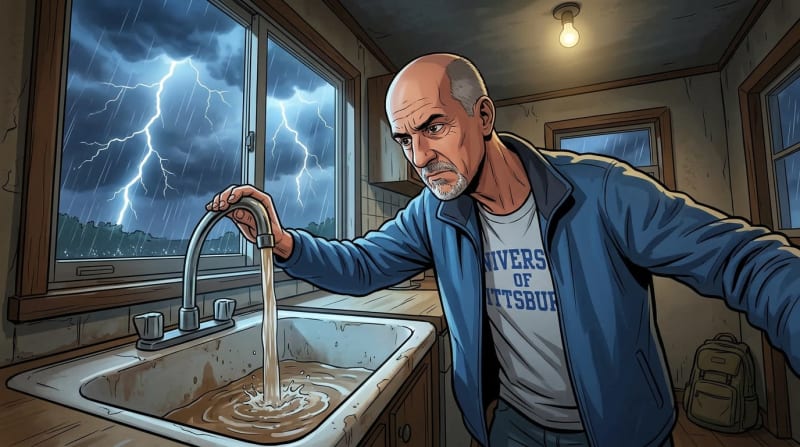
Multiple travelers on the French side — including at Orient Beach — report arriving at the tap to find yellow or discolored water. This is a real and documented phenomenon.
The SAUR official guidance is consistent across multiple press releases: after any interruption in service, unusual coloring of the water may occur due to sediment disturbed in the pipes. The recommended action is to run the tap for several tens of seconds until transparency returns. The water is not described as harmful at that stage — it's described as a cosmetic issue from pipe sediment.
The 2025 Daily Herald report states explicitly: "Yellow-tinted water, more common on the French side, is not harmful, but should be avoided for drinking."
I am not in a position to verify that claim independently. What I can say is that yellow water — regardless of its safety status — is unappetizing, and that everyone I've talked to who regularly stays on the French side, ourselves included, treats it as a visual cue to either run the tap until it clears or reach for the bottled water.
What About the Dutch Side?
What About the Dutch Side?
For context: the Dutch side of the island (Sint Maarten) operates a different water system. Seven Seas Water Group operates modern desalination facilities there that produce over 6 million gallons daily via reverse osmosis. The Dutch-side system is generally described as more reliable, with more consistent pressure and fewer outages. The water is widely reported to be safe to drink, though some visitors note a slightly different mineral taste compared to what they're used to at home.
In January 2024, the Dutch-side utility N.V. G.E.B.E. and EEASM signed a formal agreement to create a cross-border water supply connection, allowing the Dutch side to provide backup supply to specific areas on the French side during emergencies. The two interconnection points are at Oyster Pond and Bellevue.
The island is literally one island. The water systems are not.
What We Actually Do
What We Actually Do
For what it's worth — and remember, this is one traveler's personal approach, not advice — here is what we do on the French side:
We buy drinking water. There's a large grocery store in Orient Village (the commercial area behind Orient Beach) that stocks standard bottled water in 1.5-liter and larger formats at reasonable prices. We go through a lot of it on a hot week and that's just part of the trip budget.
We brush our teeth with the tap water. We always have, on all three visits, and we've had no issues. This is our choice. Other travelers make different choices. Neither approach is wrong.
We shower in the tap water without concern. This is the same choice we'd make anywhere in the EU-regulated world.
When water pressure drops or disappears, we wait. It comes back. We've learned not to plan anything that requires water pressure in the first hour of the morning until we've confirmed the supply is stable.
When the water runs yellow, we run the tap until it clears before using it for anything.
We have not gotten sick from the water on Saint-Martin. Water and food safety are separate questions with separate risk profiles — this article only addresses the tap water.
The Bigger Picture — and What's Being Done

The Bigger Picture — and What's Being Done
The water situation on the French side of Saint-Martin is not static. There is active investment underway to address the structural problems.
In January 2024, EEASM launched the Galisbay plant expansion project, targeting an increase in capacity from 8,000 to 12,000 cubic meters per day. The project was funded with €2.4 million in European Union funds secured in 2023. High-pressure pump replacements costing €800,000 were also commissioned. A mobile treatment unit was deployed as emergency backup capacity. A Dutch-side supply protocol was signed.
The 2021-2027 European Regional Development Fund (ERDF) Program for Saint-Martin includes a specific objective to improve access to water and sanitation infrastructure. The Master Plan for Water Development and Management for Guadeloupe-Saint-Martin was approved in 2022.
None of this solves the problem overnight. Infrastructure investment in a small island territory takes years to implement. But the political will and the funding mechanisms are in place in a way they weren't immediately after Irma.
What this means for travelers: the situation will likely improve over the next several years. For the near term, the practical advice remains the same as it's been for years — know that the supply is variable, have bottled water on hand for drinking, check with your accommodation about whether they have a private cistern or filtration system, and don't be surprised if the tap runs dry for a few hours on any given day.
If You're Visiting Orient Beach

If You're Visiting Orient Beach
A few things specific to Orient Bay that I can speak to from experience:
The accommodations vary significantly in how they handle the water situation. Some properties have private cisterns that buffer against supply interruptions — meaning your tap keeps running even when the network is down. Others are directly connected to the municipal supply. It's worth asking when you book.
The hotel at Orient Beach (Club Orient, the naturist resort, and others) appear to have their own storage systems that at least partially buffer the public supply. The experience at a standalone villa rental can be more variable.
The grocery stores at Orient Village carry well-stocked bottled water supplies. You won't have trouble finding what you need.
And the beach — the actual beach water, that lagoon — is a different question entirely. The Saint-Martin water quality report from September 2025 showed both the north and south ends of Orient Bay rated as good quality for swimming, with E. coli and enterococcal levels well within safe ranges. Whatever is happening with the tap water, the bay itself was testing well as of last fall.
The Question Worth Sitting With
The Question Worth Sitting With
Saint-Martin's water situation is, at bottom, the story of an island with no natural freshwater trying to deliver reliable drinking water to 40,000 residents and hundreds of thousands of tourists annually, through infrastructure that was devastated in 2017 and is still being rebuilt, run by a governance structure that involves multiple organizations with different interests and contractual relationships.
That's not a failure of effort or commitment. It's a genuinely hard problem. The French state, the EU, EEASM, and SAUR are all investing in solutions. The island is not standing still.
For now — the water cuts are real, the yellow water is real, the supply variability is real. So is the fact that millions of visitors and 40,000 residents live with this water every year, and most of them are fine.
We buy our drinking water at the grocery store. We love Orient Beach. we'll be back.
— Adam
⚠️ Reminder: Nothing in this article is medical, health, or safety advice. I am a traveler writing about my personal experience and publicly available reported facts. Water conditions change. Always consult a physician for health guidance, verify current conditions with your accommodation, and check EEASM and SAUR Saint-Martin for current service announcements before and during your trip.
Content ID: 5sIXy2BoG1EURN8HF9yhHUGC
See an error? Tell us.


Comments
Share with the Community