What Slow Travel Actually Feels Like (And Why More People Are Choosing It)
The Short Version
- Slow travel content on TikTok grew 330% in 2025, and a majority of travelers surveyed by KAYAK now say they prefer spending more time in fewer places — this is no longer a fringe lifestyle choice.
- The real shift happens in month two, not month one — experienced slowmads consistently report that deep work and genuine local connection only emerge once the basics of a new place become automatic.
- Chiang Mai offers one of the lowest entry points into extended travel, with a furnished studio running around $300 per month and total comfortable living costs under $1,200 — including a gym pass, motorbike, and daily cafe time.
- Accommodation math actually favors slow travelers: a place that costs $80 a night short-term frequently rents for $1,200 to $1,500 for a full month, and cooking at home eliminates most of what remains.
- Tbilisi, Georgia stands out as the most underrated option, offering livable costs under $1,000 per month, genuinely fast Wi-Fi, a straightforward year-long remote worker visa, and a food culture that surprises nearly everyone who shows up.
The Problem With Seeing Everything
The Problem With Seeing Everything
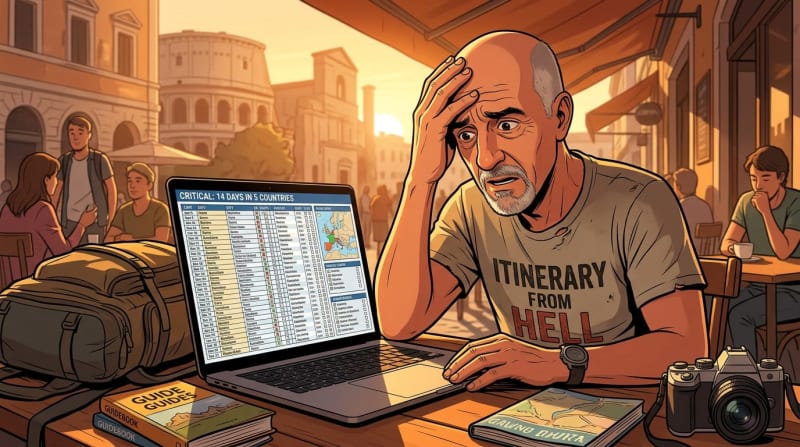
There is a specific kind of exhaustion that only travelers know. You have seen twelve cities in fourteen days. You have photographs of everything and memories of almost nothing. You come home and someone asks what the trip was like, and the honest answer is: fast.
We treated travel as a to-do list to be conquered for years — collecting passport stamps like trophies, prioritizing breadth over depth, packing high expectations into tight itineraries and returning home more depleted than when we left. the vacation from the vacation became its own cliche.
Something is changing. Slow travel content on TikTok grew 330% in 2025, and over half of travelers surveyed by KAYAK's 2026 What the Future Report now say they prefer spending more time in fewer places, focusing on quality over quantity. That is not a niche preference. That is a majority.
The shift has a name. It is called slow travel — and if you have not looked at it closely yet, it is worth understanding what it actually involves, because it is different from what most people imagine.
What Slow Travel Actually Means

What Slow Travel Actually Means
Slow travel is not about moving slowly through a place in the tourist sense. It is about staying long enough for a place to stop being new.
Researchers who study the field describe it as making conscious choices about deceleration rather than speed — re-engineering time into a commodity of abundance rather than scarcity, and reshaping the traveler's relationship with places by encouraging deeper engagement with the communities they move through.
In practice, this means staying somewhere for weeks or months rather than days. The term slowmad — a blend of slow and nomad — has emerged to describe the specific version of this that remote workers and semi-retired travelers practice. According to Nomad Labs, the most common pattern is three to four bases per year, each lasting two to four months — enough variety to satisfy curiosity while allowing genuine immersion in each location.
You are not on vacation. You are not quite living there, either. You are something in between: a temporary resident. You find a grocery store you like. You become a regular somewhere. You start to notice things — the way a neighborhood changes on a Sunday morning, the regulars at the cafe two blocks over, the shortcut nobody tells visitors about.
By day three, you are no longer a tourist. You are a temporary resident — and that shift allows something that a revolving door of guests can never achieve: a sense of belonging that takes time to earn.
Why the Second Month Is Different

Why the Second Month Is Different
The first month of any extended stay is still adjustment. You are learning the transportation, navigating the apartment, figuring out where things are. It feels productive and interesting, but you are still orienting.
Experienced slowmads consistently report that their most productive and personally meaningful periods happen in month two and three — not month one. The first month involves discovery and adjustment. The second brings flow. The third is where deep work and deep connection happen naturally because everything around you has become automatic.
The same pattern holds for relationships. In three weeks, you meet people, have interesting conversations, maybe share a few meals — then you leave and everyone moves on. Three months changes the dynamic entirely. You see the same people repeatedly. You become a regular somewhere. You get invited to things by locals, not just other tourists.
This is the thing that photographs cannot capture. The bakery owner who learned your order. The neighbor who started nodding at you in the hallway. The group chat you got added to. These are not dramatic moments. They accumulate quietly, and when they do, the place feels different — not like somewhere you visited, but somewhere you briefly belonged.
Researchers studying slow tourism describe this as meaningful deceleration — the mental and emotional reset that happens when travelers escape the relentless pace of modern life and experience genuine connection with both places and people, now recognized as crucial for personal well-being (Tandfonline, 2025).
Where Slowmads Are Going in 2026
Where Slowmads Are Going in 2026
The infrastructure for extended travel has matured significantly. Over 65 countries launched digital nomad visas in 2026, with income thresholds ranging from $684 to $3,500 per month — meaning the legal pathway to stay longer in one place is available across most of the world's most appealing destinations (Digital Nomad Visa Index, Immigrant Invest 2026).
A few cities have emerged as the clearest starting points.
Lisbon remains the gold standard for European slow travel. Living costs run roughly $2,000 to $2,500 per month including accommodation, food, and transportation, with internet averaging 150 Mbps in major areas. Portugal's D8 visa is renewable up to five years and provides a pathway to permanent residency for those who want it. The city has mild weather year-round, an established nomad community, and enough cultural depth to sustain months of exploration without exhausting itself.
Medellin, Colombia offers something different: a comfortable lifestyle for $800 to $1,200 per month, with a two-year renewable visa and income requirements among the lowest in the world — approximately $1,100 per month. Known as the City of Eternal Spring for its stable year-round climate, Medellin has transformed dramatically over the past two decades into a city with a thriving arts scene, reliable infrastructure, and one of the most welcoming expat communities in Latin America.
Chiang Mai, Thailand has anchored the slowmad movement in Southeast Asia for years. A modern studio with Wi-Fi and air conditioning rents for around $300 per month. Street food runs about $1.50 per meal. Most people manage comfortably under $1,200 monthly including a gym pass, motorbike rental, and daily cafe time (DigiDiamo, 2026). The city sits in the mountains of northern Thailand, surrounded by temples and forest, with a digital nomad infrastructure that has had fifteen years to mature.
Tbilisi, Georgia is the most underrated option on this list. You can live well here for under $1,000 per month — rent around $350, ubiquitous cafes, fast Wi-Fi, good wine, and a visa program that is genuinely straightforward. Georgia offers year-long remote worker visas with minimal friction, a city that still feels authentically itself rather than curated for visitors, and a food culture that surprises almost everyone who encounters it.
How to Try It Without Upending Your Life
How to Try It Without Upending Your Life
You do not need to quit your job or sell your house to test this. The slowmad approach is scalable.
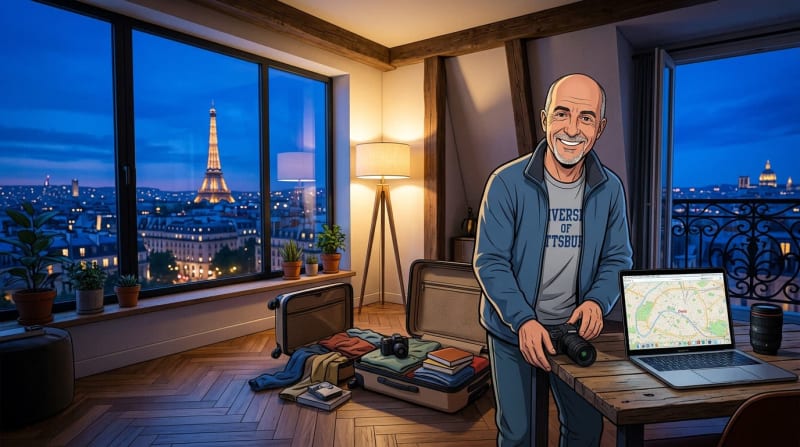
The most practical starting point is a test month: pick a city you already like, commit to 30 days, and treat it as a living prototype — choosing a base with strong Wi-Fi, walkable neighborhoods, and a time zone that does not wreck your professional obligations.
A few things worth knowing before you go.
Accommodation costs drop significantly for extended stays. Platforms like Airbnb and Flatio offer substantial discounts for monthly bookings — often reducing nightly rates by 30 to 50%. A place that costs $80 a night short-term frequently rents for $1,200 to $1,500 for the month. Running your own kitchen eliminates most restaurant costs. The math of slow travel tends to be better than fast travel, not worse.
Restlessness is real. If novelty is your primary motivation for travel, staying put can feel like quitting cold turkey. A practical fix: plan short weekend trips to nearby places rather than full relocations — enough movement to satisfy curiosity without abandoning the base you have built.
Visa rules vary and require attention. Most popular slow travel destinations offer tourist entry of 30 to 90 days, which is enough for a test run. For stays beyond that, digital nomad visa programs provide legal pathways. VisaHQ maintains a current guide to programs across 60 countries if you want to compare requirements before committing.
The larger point is simpler than any of the logistics. Slow travel eliminates what psychologists call the Zeigarnik effect — the tension of an unfinished itinerary — by removing the task of tourism altogether. A single morning watching the tide turns out to be more restorative than a week of museum hopping.
That is what people who have done it tend to say. Not that they saw more, but that they remember more. Not that the place was perfect, but that it started to feel like theirs.
Content ID: ZAj8DGnCuA8MVV9R7nelOPTM
See an error? Tell us.
Comments
Share with the Community