
Hiking Mallorca's Serra de Tramuntana: The West Coast Trail from Deià to Cala de Deià
The Short Version
- The Serra de Tramuntana earned UNESCO World Heritage status in June 2011 — recognized not just for dramatic scenery but for a civilization literally built in stone, where Arab irrigation methods from the 9th century were layered onto Christian land management after the 1229 conquest to create terraces still in active use today.
- Dry stone walls on this trail were constructed over 800 years ago with no mortar and no machinery, yet they continue functioning as working agricultural infrastructure — not preserved relics, but actual farms still producing oil, fruit, and wine.
- Robert Graves arrived in Deià in 1929 on the recommendation of Gertrude Stein, found sun, mountains, and no politics, and stayed until his death in 1985 — then actively shaped the village's architecture by insisting new buildings match the existing honey-colored stone style, which is why the place still looks the way it does.
- Ca's Patró March has been serving fresh fish at Cala de Deià for more than a century from a cliff-edge table directly above the water — it gained a second wave of international attention after appearing in the BBC adaptation of The Night Manager, but the formula has never changed: fish caught that morning, sea directly below.
- The round trip from Deià village to the cove is only 4–5 kilometers with about 230 meters of elevation gain, but that short distance carries the defensive watchtower history of 16th-century corsair raids, five-hundred-year-old olive trees, and a rocky cove where the water is clear enough to count the boulders on the bottom from thirty meters above.
The Tramuntana Coast Belongs to Hikers
The Tramuntana Coast Belongs to Hikers
I want to say we had a plan. We did not have a plan.
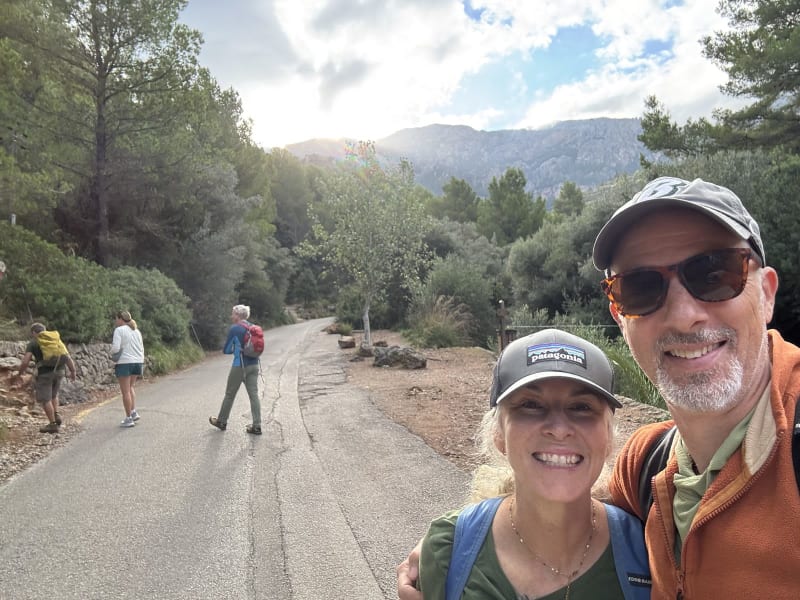
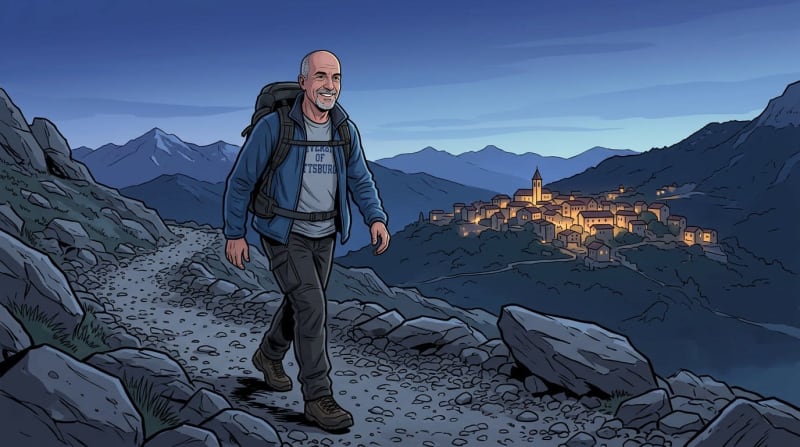
We knew we were near Deià. We knew there were trails. Someone in our group had heard that if you walked down toward the coast from the village, you could reach a cove so clear it looked invented. So we laced up our shoes on a morning that felt like it was trying to decide between clouds and sun, and we followed a road out of town.
That's how the best days start, in my experience. Not with logistics but with intention.
What we had stumbled into — though stumbled is too clumsy a word for something this beautiful — was a section of the GR221, the long-distance trail known as the Dry Stone Route, which winds for 140 kilometers along the spine of the Serra de Tramuntana from Port d'Andratx in the southwest to Pollença in the northwest. We were hiking one small fragment of it — the stretch between Deià and the coast — but even this short section is enough to understand why people come from across Europe to walk it in its entirety.
The Serra de Tramuntana was named a UNESCO World Heritage Site in June 2011, recognized not just for its natural drama but for something rarer: the almost perfect symbiosis between human hands and mountain terrain built across thousands of years. What you walk through on this trail is not wilderness. It is a civilization expressed in stone.

The villages you pass through and glimpse from above — Deià, Valldemossa, Sóller — have been here since before maps. Deià itself takes its name from the Arabic ad daia, meaning simply "the village," a designation from the Moorish occupation of the 8th century. After the Christian conquest, it flourished thanks to its fishing and olive and citrus fruit cultivation. You can see all three in a single glance from the trail: the sea where the boats went, the groves where the oil came from, the terraced orchards cut into every available slope.
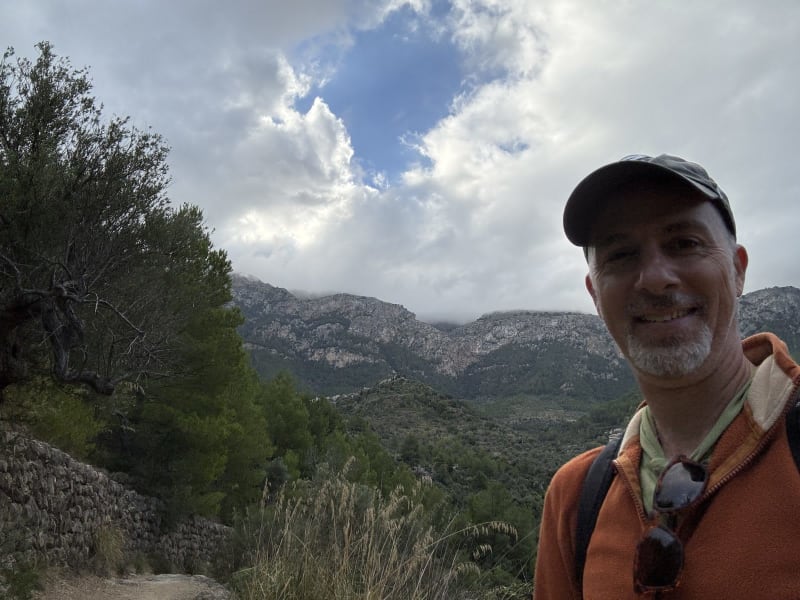
What does it mean to walk into a landscape where people have been solving the same problems — water, soil, shelter, community — for a thousand years, and solved them so beautifully that the world declared the solution worth protecting? That question kept turning over in my head somewhere in the first kilometer, as the road narrowed and the stone walls closed in and the mountains filled the sky.
The Trail from Deià: Stone Lanes and Living History

The Trail from Deià: Stone Lanes and Living History
The walk begins quietly. You leave the village on a narrow paved lane, the kind that's barely wide enough for a single car, flanked on one side by a traditional Mallorcan finca in honey-colored stone, and on the other by a dry stone terrace wall that has probably been standing longer than the United States.
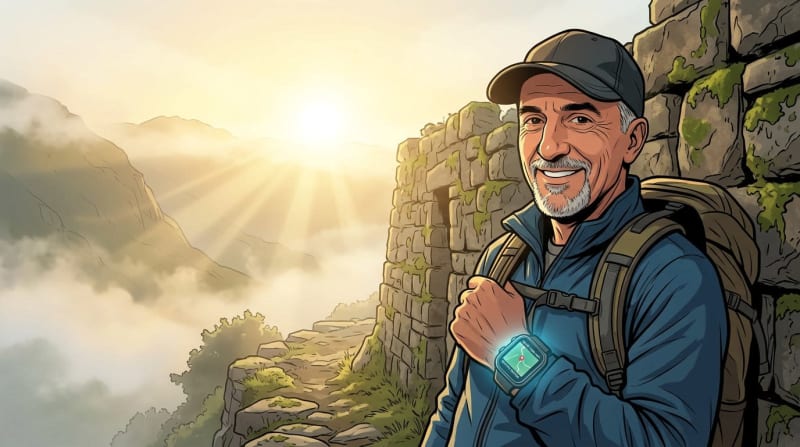
This is the gift the trail gives you first: slowness. Not slowness as deprivation but slowness as access. You cannot drive this. You cannot rush through it. The lanes force you to walk at the pace things were built for, and at that pace, you start to see what you would otherwise miss.
The dry stone walls are worth stopping to understand. These terraces, many constructed over 800 years ago, continue functioning today through carefully maintained dry stone walls and drainage systems. No mortar. No machinery. Just stone selected and fitted by hands that understood how weight distributes across limestone, how drainage works on a slope, how to make something last without forcing it. According to UNESCO's World Heritage designation, this landscape embodies millennia of communities finding ingenious ways to farm nearly impossible terrain — Arab water management combined with Christian agricultural knowledge, exchanged across centuries of cultural contact, producing something neither tradition could have built alone.

Someone in our group stopped at a particularly gnarled olive tree and pointed it out to the rest of us. We all stopped. You do, when you're confronted with a living thing that might be five hundred years old. The trail through this section runs through ancient olive groves that have been tended continuously across centuries of different rulers, languages, and religions. The trees do not care about any of that. They just keep producing.

Along the way, carob trees mark the older field edges — their long dark pods hanging like something the trail itself is offering you. The Mallorcan countryside has a botanical density that rewards attention: Mediterranean scrub pressing in at every edge, wild rosemary, and through gaps in the trees, the occasional flash of turquoise so blue it seems wrong for the scale.
What gifts do ancient places give? Not just beauty. They give perspective. The stone walls don't care about your schedule. The olive trees don't care what year it is. There's a freedom in that indifference that feels, paradoxically, like belonging — like you've been let into something larger than the present moment.
Stone Walls, Wild Goats, and Ancient Farms

Stone Walls, Wild Goats, and Ancient Farms
The trail climbs and opens. The scrub gives way to limestone outcroppings, and the views get serious.
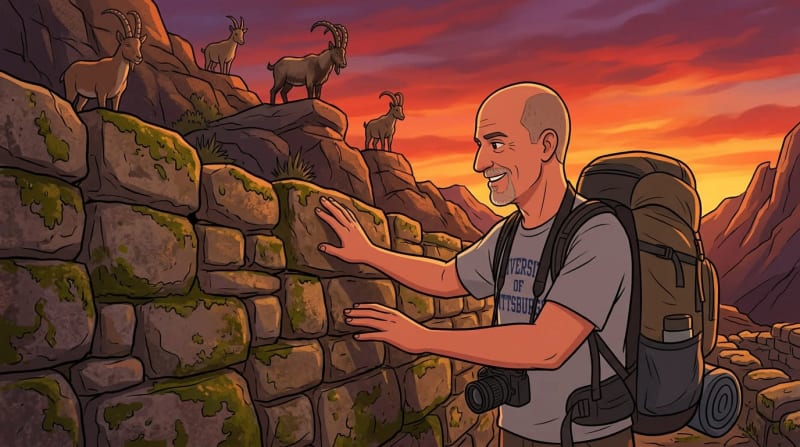
We saw the goat before it saw us — a dark, compact Mallorcan mountain goat balanced on a rocky ledge above an ancient terraced wall, utterly unbothered by the altitude, the exposure, or us. It stood there for a long moment before picking its way upward with a calm that felt almost pointed. The Tramuntana has been managed grazing land for centuries. The goats have not forgotten this.
The farms you pass — or glimpse above you through the pines — are the possessions, the great rural estates that organized agricultural life here from the medieval period onward. According to UNESCO's cultural landscape designation, what makes this terrain exceptional is how it embodies the meeting of two great agricultural traditions: the sophisticated Arab irrigation systems introduced in the 9th century, layered onto the Christian land management methods brought after the conquest of 1229. The result is terraces and water channels that have been in continuous use ever since — not preserved, but actually working.
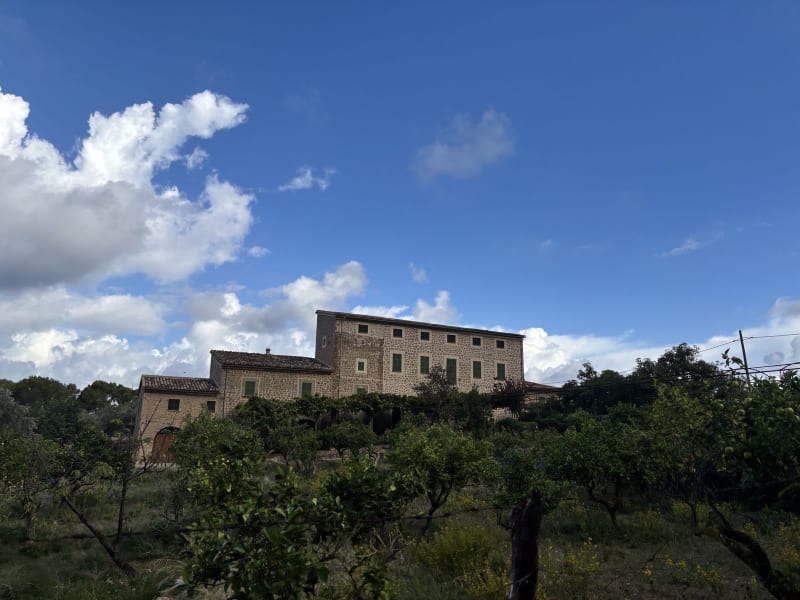
One such finca sat above a citrus orchard we passed — three stories of pale stone, green shutters, a tower that might have watched for pirates, a doorway set into thick walls that have absorbed the weather of four centuries. The orange trees in the orchard below it were heavy with fruit. Something about the combination — ancient architecture, working orchard, blue sky piling with clouds behind the peaks — felt like a scene from before history was written down.
These buildings are not ruins. They are not museums. They are still farms, still lived in, still producing oil and fruit and wine in methods that haven't needed to change because they work. That continuity is one of the most quietly extraordinary things about the Tramuntana: it is a landscape that has been cared for without interruption, and you can feel it.
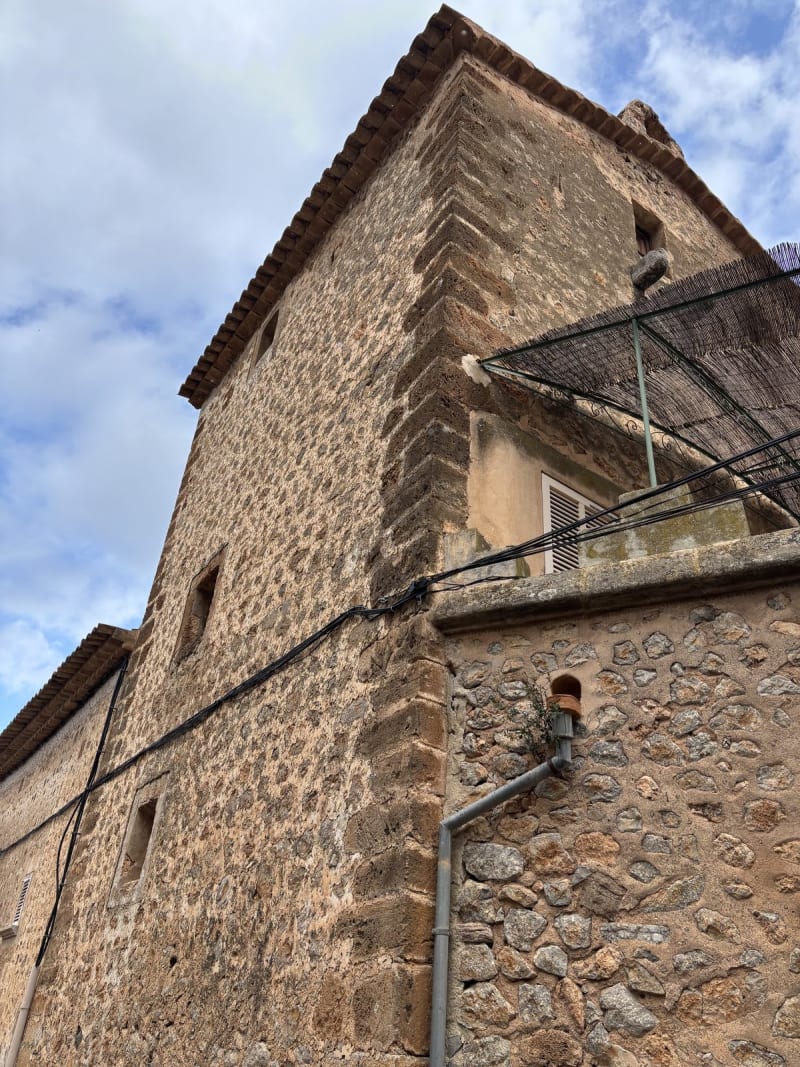
The watchtowers are another layer of the story. Almost every village and estate along this coast has one — built to watch the sea for corsair raids from North Africa, pirates who came for silver, for captives, for whatever could be carried away from a coast with no other defense. According to records of Son Marroig, the defensive tower there was built in the 16th century specifically because Sa Foradada's sheltered rock formation made it a favored landing point for raiding parties, and the last recorded kidnapping of a Deià resident by corsairs reportedly happened in the 18th century. The towers have been watching the sea ever since. Now they watch for hikers with cameras.
The Moment the Sea Appears
The Moment the Sea Appears
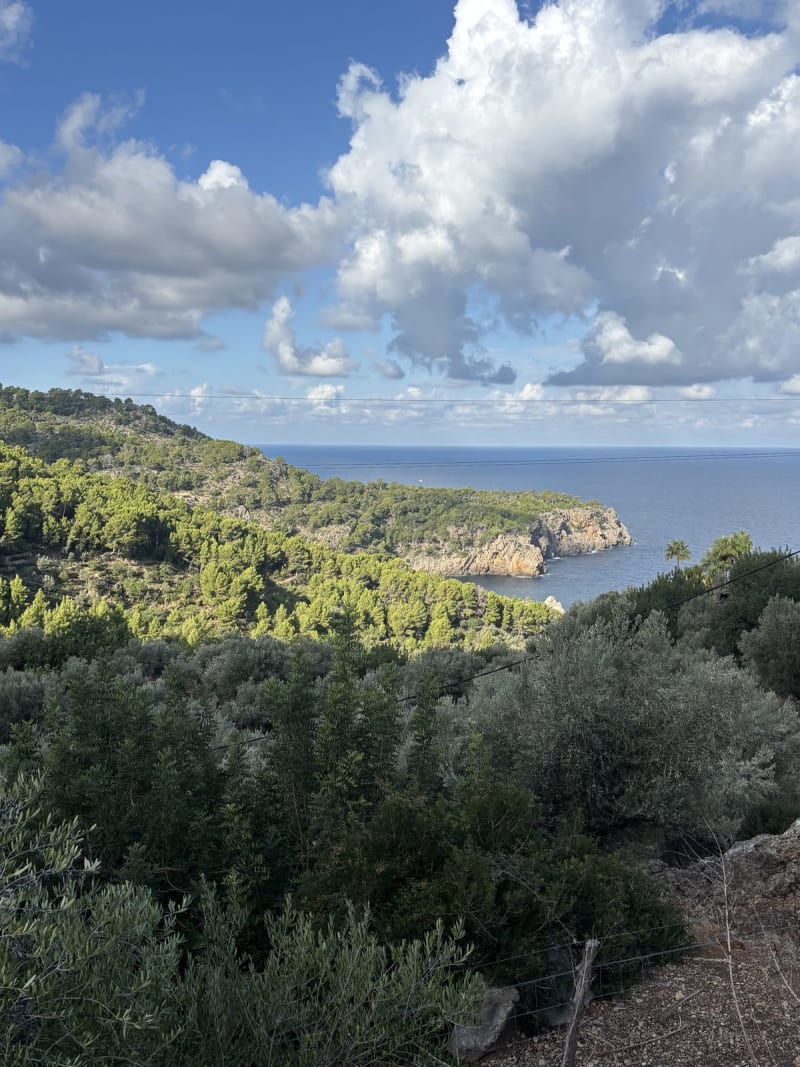
There is a specific moment on this trail when the mountains step back and the Mediterranean takes over the sky.
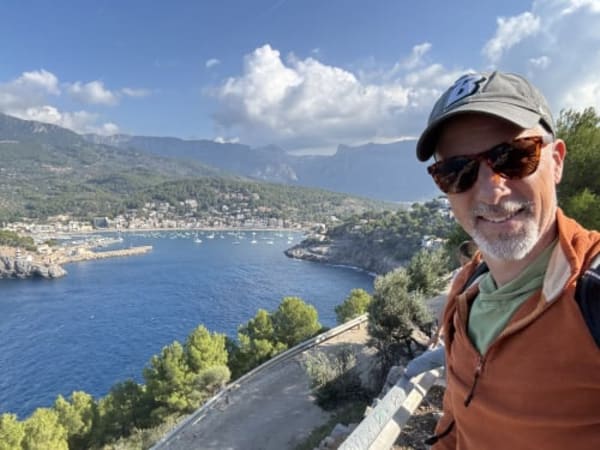
You have been walking in a contained world: stone, pine, olive, rock. The path drops a fraction, rounds a turn, and then there it is — the sea from above, a blue so deep it seems to have weight, a pine-covered headland pushing out into it, the horizon impossibly clean and far. It arrives without warning and it stops you completely.
I did not expect it. I know, intellectually, that this is an island, that the sea is always close. But the mountains have a way of making you forget that, and when it comes back — all at once, at full scale — something adjusts in your chest.
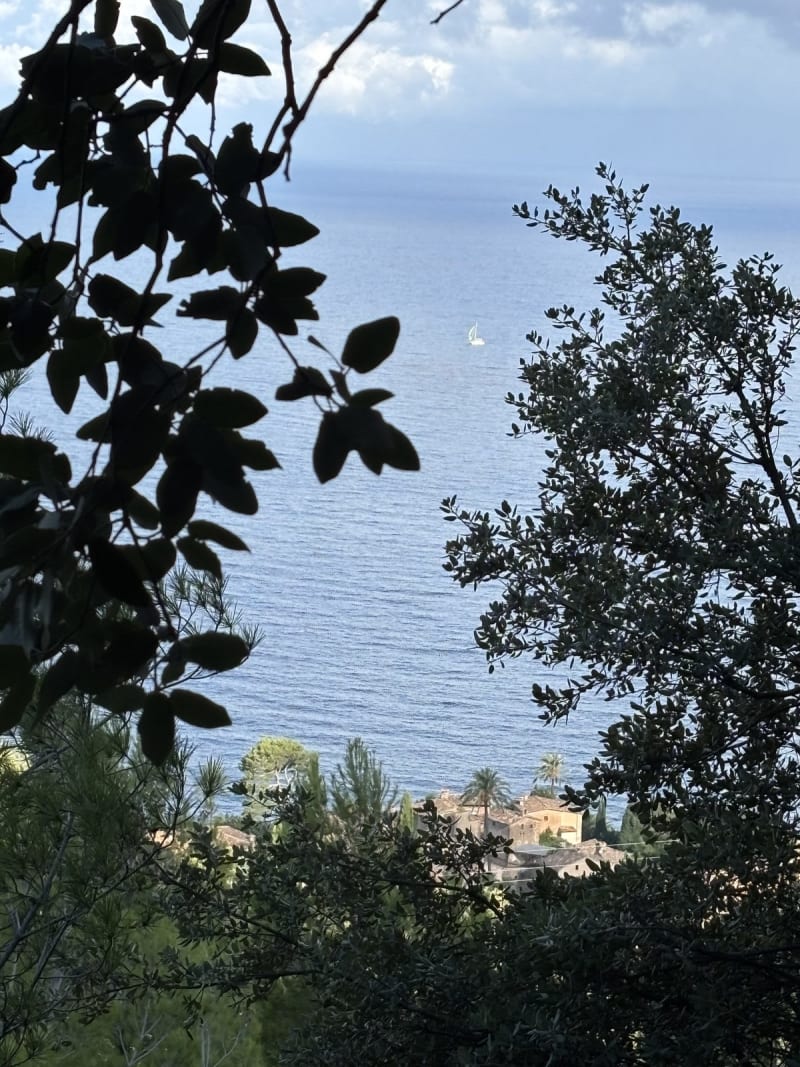
A sailboat moved through the blue far below, visible for a moment through the silhouetted leaves of a carob tree. A village crouched at the waterline. The light was the kind that exists only in the Mediterranean in autumn, when the summer heat has burned off and the air goes translucent. Everything looked like it was being seen for the first time.
This is the part of the coast where the Archduke Ludwig Salvator of Austria walked in the 1860s and could not leave. Ludwig Salvator settled on Mallorca, buying up unimproved areas of land in order to preserve and enjoy them. He was an aristocratic eccentric by the standards of his time — he dressed in peasant clothes, explored the mountains on foot, wrote a nine-volume study of Balearic culture and wildlife — but by any honest reckoning he was just a man who could not stop looking at this coast and wanted to protect it from being ruined. His main residence, Son Marroig, sits nearby, and his white Carrara marble pavilion marks the exact spot above Sa Foradada where the view is best. He was, in the truest sense, ahead of his time.
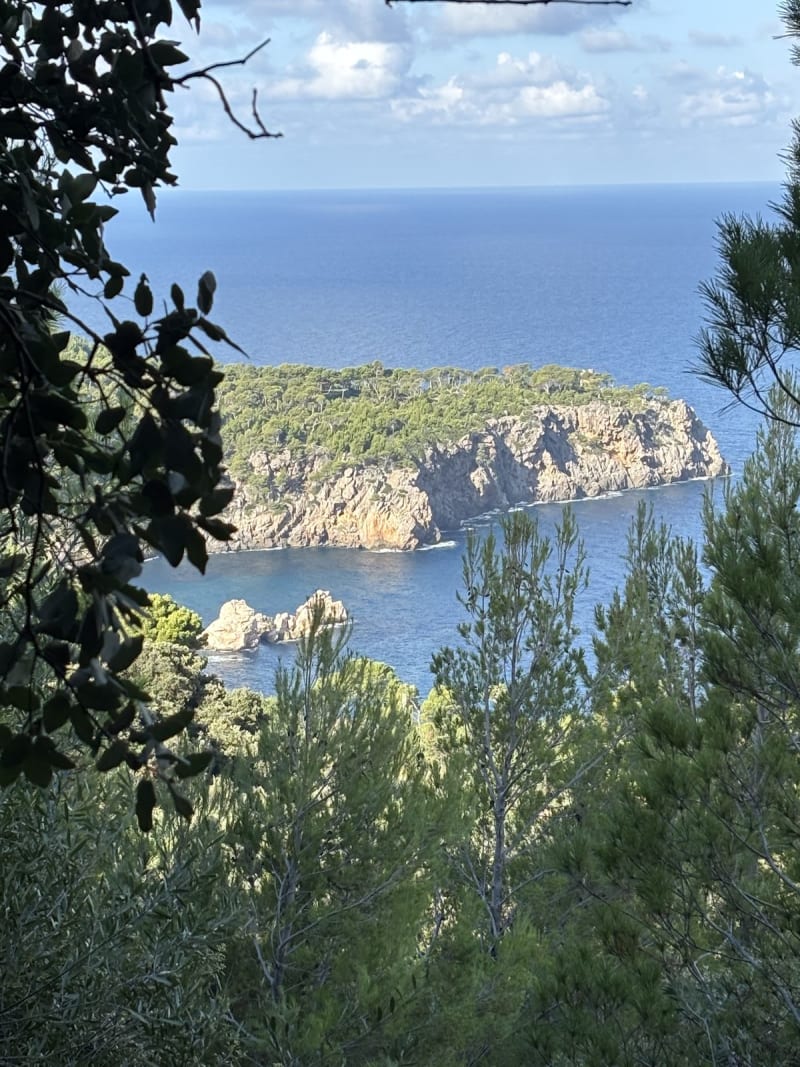
Sa Foradada itself — the dramatic rocky peninsula with its distinctive hole punched through the rock by centuries of wave action — appeared through the tree branches like something dreamed. Its cliffs drop straight into the water in that reddish-orange limestone the Tramuntana is made of. There are no words that do justice to the color of the sea at its base. Ultramarine is too technical. Electric is too garish. It is just Mediterranean, that particular blue, the one that makes you understand why every civilization that ever touched this sea thought it was the center of everything.

Looking at the map, we were somewhere between Deià and Port de Sóller, on the coastal section above Son Coll and Alconàsser — a stretch of trail that is not long by any measure, perhaps five kilometers round trip with the detour to the cove, but that carries more history per meter than almost any trail I have walked.
What possibility exists when you slow down enough to actually see where you are? This coast has been asking that question for centuries. The answer, it turns out, is exactly this much.
The Descent to Cala de Deià
The Descent to Cala de Deià
The trail to the cove drops sharply. This is where you want your shoes.

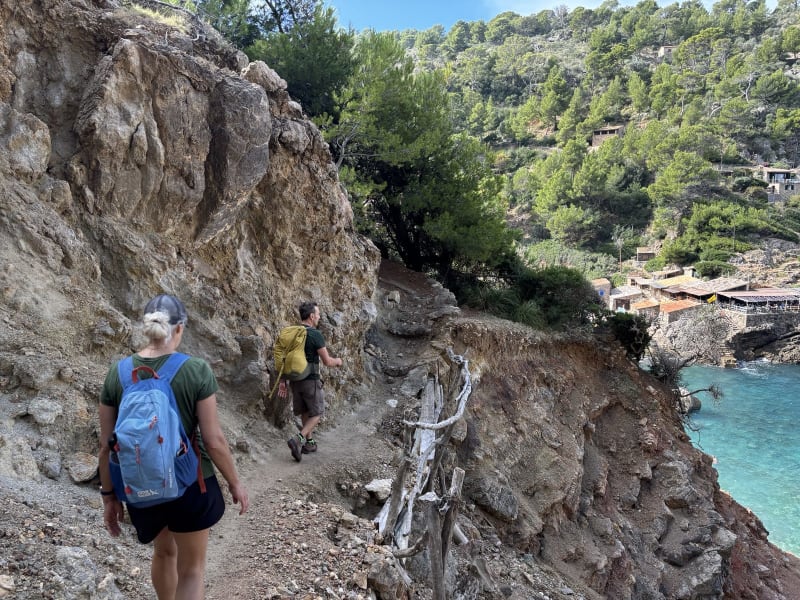
The path narrows to a ledge in places, with the rock face close on one side and a wooden post fence — sun-bleached, salt-stripped, doing its honest best — separating you from a sheer drop to the turquoise water below. The hikers ahead of us picked their way down with that careful, deliberate rhythm that exposed mountain trails require. You are very present on this section. The view below makes sure of that.
The trail descends through olive groves with sweeping ocean views before dropping into the village lanes — a moderate effort with serious reward. The reward reveals itself in full as the descent delivers you above the cove. You get the aerial view first: a horseshoe of turquoise water cupped by reddish cliffs, a handful of stone fishing boathouses built directly into the rock, people swimming in water so clear you can count the rocks on the bottom from thirty meters above.

Cala de Deià is not a beach in any conventional sense. There is no sand. There are rounded pebbles, limestone boulders, the boathouses of the llauds (the traditional Mallorcan wooden fishing boats) that have used this cove for generations, and a sea that rewards the swim with the kind of cold, clean, absolutely transparent saltwater that you remember for years. Robert Graves swam here daily, reportedly arriving on a donkey from his house above the village. You are walking in his footsteps — or at least the donkey's hoof-prints bearing said giant.
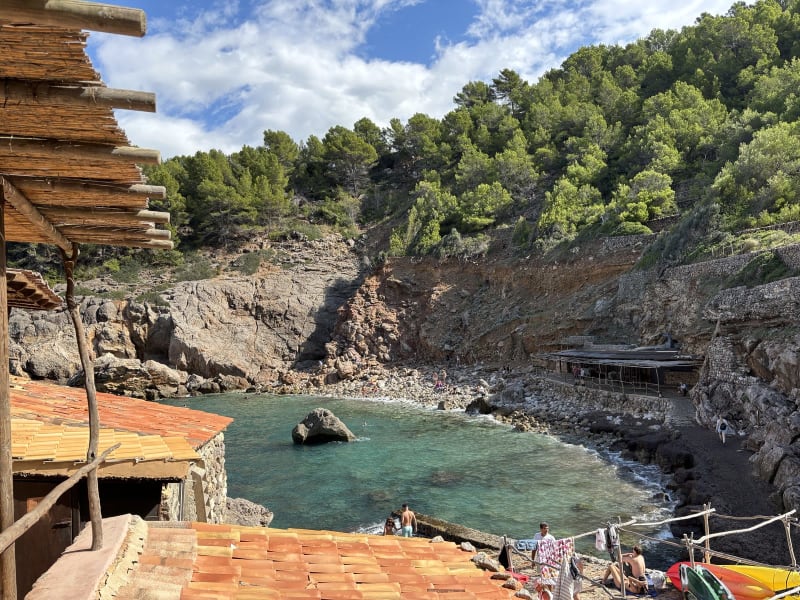
The boathouses at the base of the cove are orange-tiled, rough-timbered, built in the kind of practical style that exists before aesthetics becomes a separate consideration from function. They have been here a long time. The kayaks pulled up at the water's edge are newer. People were spread along the rocks sunbathing, swimming, watching the light on the water. A few fishing lines in the water. Nobody in a hurry.
Ca's Patró March perches on the rocks directly above the water, and we ate there. It has been serving fresh fish at this cove for more than a century, and it has not complicated the formula: the fish is caught that morning, the tables are set on the cliff edge, the sea is right there below you. The sign at the entrance said CASH ONLY — a practical reality on a coast where cellular networks and credit card machines have an understanding that they will not always cooperate. We paid by card anyway. Nobody seemed surprised.
What I remember is sitting at the very edge of a limestone cliff, the turquoise water directly below us, the food arriving simple and impossibly fresh, the sun moving across the water. There is no view at that restaurant that is not the best view you have ever had at a meal. The setting has long been a favorite among artists, writers, and celebrities — it gained a second wave of international attention after appearing in the BBC adaptation of The Night Manager — but none of that matters when you are actually there. What matters is the fish, and the water, and the specific quality of light that exists only on this coast in this season.
What gifts has this cove been giving, quietly, for all this time? The same ones. The cold water. The fresh catch. The particular peace of a place that has not needed to change because it was already exactly right.
Deià: The Village That Earned Its Reputation
Deià: The Village That Earned Its Reputation
The walk back up leads you into Deià itself, and Deià rewards the arrival.
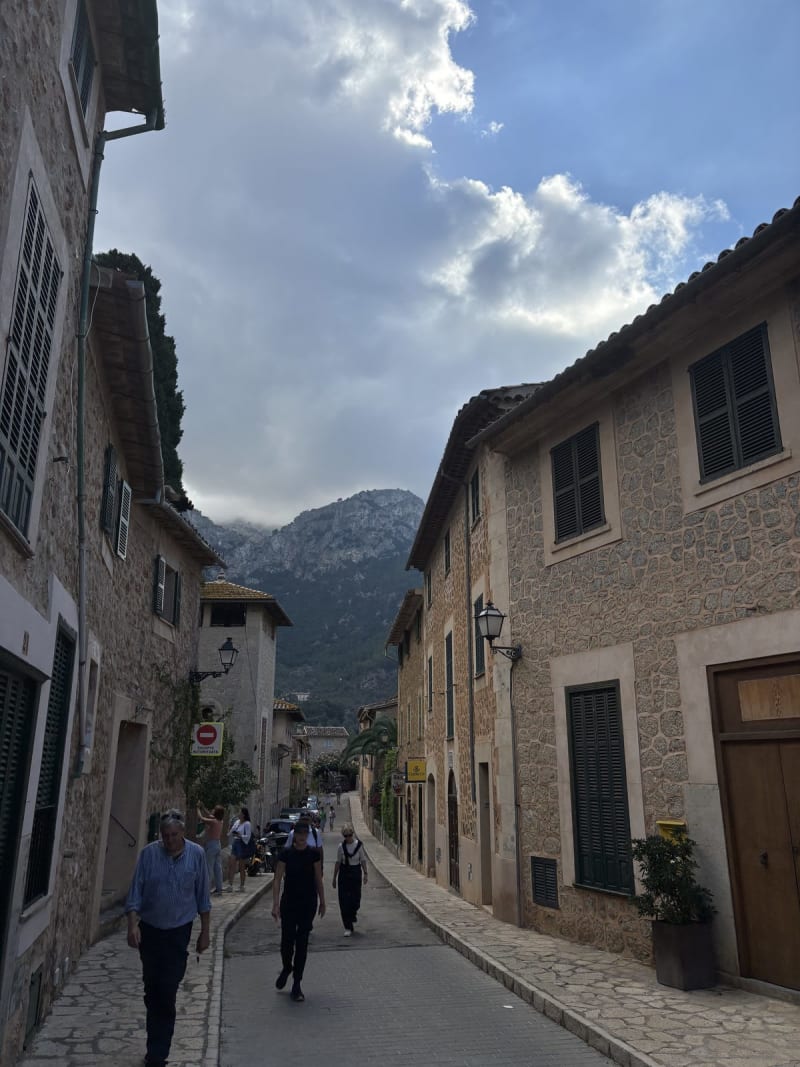
The streets are cobblestone and narrow, stone buildings rising close on both sides, the odd gas lamp, green shutters, mountain filling the end of every lane like a painting someone forgot to move. The village has approximately 850 residents. It has been continuously inhabited, in various forms, since prehistoric times. Its current character — artistic, international, quietly expensive, deeply beautiful — took shape in the 20th century, when a British poet arrived and could not leave.
Robert Graves moved to Deià in 1929 at the recommendation of the American writer Gertrude Stein, bringing with him the poet Laura Riding. He found everything he needed: sun, sea, mountains, spring waters, shady trees, no politics, and a few civilized luxuries such as electric light and a bus service to Palma. He stayed, with interruptions during the Spanish Civil War and World War II, until his death in 1985. He is buried in the small cemetery behind the hilltop church, where visitors still leave poems on his grave.

Graves's influence on the village went beyond residence. He helped save the village from the intrusion of mass tourism by insisting that the architecture should be of the same style as the existing stone-faced houses. The honey-colored stone you see everywhere, the green shutters, the coherent scale — this is partly the result of a poet deciding, firmly, that beauty was worth protecting. The village listened. It still does.
The artists followed him, and the artists attracted everyone else. Graves's presence drew artists, musicians, and writers from around the world, cementing Deià's status as a bohemian retreat. The list of those who have lived or worked here is genuinely extraordinary: Joan Miró, Ava Gardner, Gabriel García Márquez, Stephen Hawking, and in more recent decades Michael Douglas and Bob Geldof, among others. The Engel & Völkers sign at the base of a centuries-old stone building, the dramatic limestone peak directly above it, tells the whole story in a single frame: Deià has become one of the most sought-after addresses in Europe, and it wears this with a remarkable degree of grace.
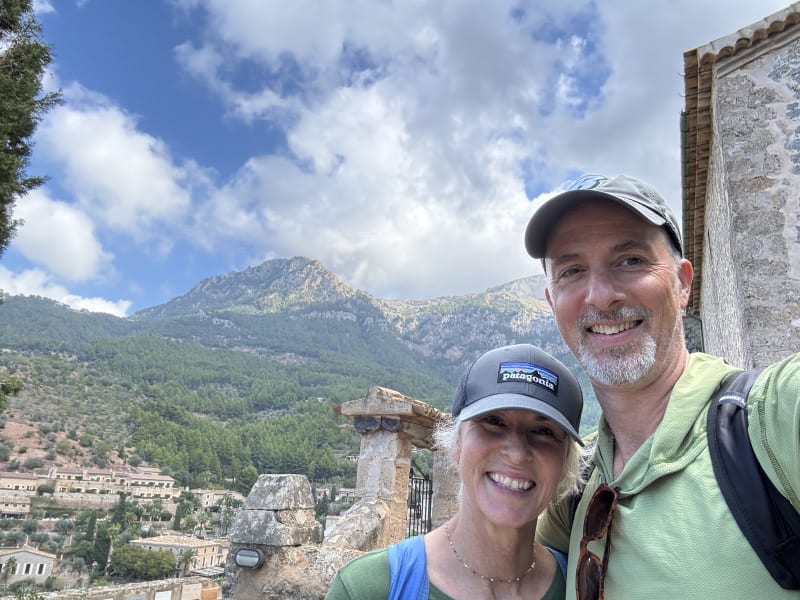
It is possible to visit Deià as a transaction — a pretty village checked off a list, a photo taken, a coffee had, a car retrieved. Many people do exactly this. But the village offers something else to those who slow down: the sense that belonging here, even briefly, even for an afternoon after a hike, is something that has been made available to anyone who comes honestly. The trails are free. The light on the stone is free. The view from the cemetery where Graves is buried, looking out over the mountains and the sea, is free.
What would it look like to be genuinely present in a place for the first time? To arrive without a plan, follow a trail, discover a cove, walk into a village that has been making people feel this way for the better part of a century?
We know the answer. We lived it on a morning that started with someone saying: I think the trail goes this way.
Planning Your Hike
Planning Your Hike
The Deià to Cala de Deià trail is accessible year-round, though spring and autumn offer the best conditions — mild temperatures, soft light, fewer crowds. According to trail records, September through October is the most popular time to visit, and the trail is usually very busy during peak season.
The round trip from the village to the cove is approximately 4–5 kilometers with around 230 meters of elevation gain, and takes 2–3 hours depending on your pace and how long you linger at the cove. Wear sturdy shoes with good grip — many sections of the trail are rocky or gravelly, and you'll want shoes that won't slip. Bring water; there are no reliable water sources on the trail itself.
Deià is served by the TIB Route 203 bus between Palma and Port de Sóller, which stops in the village. Parking in Deià is scarce in summer and best avoided on weekends. The bus is the honest answer.
Ca's Patró March at the cove is open from approximately late March through September and books weeks in advance during summer. Reserve before you go — and bring cash as a backup. The sign says cash only, a nod to the cellular unreliability on this coast, though we paid by card without issue. Either way, make a reservation. The meal is worth the planning.
The Robert Graves House Museum, Ca N'Alluny, is a fifteen-minute walk from the village center on the MA-10 road toward Sóller. Give it an hour.
The GR221 Dry Stone Route runs the entire length of the Serra de Tramuntana and can be walked in stages using the network of public refuges. The stage between Deià and Sóller alone is worth planning a trip around.
What awaits on this trail is not complicated to describe: mountains, sea, stone, history, and a cove at the bottom that will make you want to come back. The only question left is when you will go.
Content ID: tlbLxSjQ2CPkUvKEk0bQTHYa
See an error? Tell us.

Comments
Share with the Community