
Palma de Mallorca: What Happens When You Stay Long Enough to Feel Like You Live There
The Short Version
- La Seu Cathedral was built in the 13th century, later modified by Antoni Gaudí, who added what is considered one of the world's largest rose windows — and the stone still commands the Palma coastline seven centuries on.
- Can Forteza Rey, a Modernista building completed in 1902, is covered in mosaic tile and ornate ironwork that catches afternoon sun and transforms the entire facade — and most visitors walk past it entirely.
- Staying in an Airbnb in the Casc Antic with a kitchen and no car turns out to be the correct configuration for understanding Palma — the old quarter is pedestrianized, the streets lead somewhere good in every direction, and the city has no dead ends.
- La Llotja, designed by Guillem Sagrera in the 15th century, served as Palma's merchant exchange when Mallorca was a more significant Mediterranean trading hub than Barcelona — today there are palm trees out front and café tables in its shadow.
- Dinner before 9pm in Palma marks you as a tourist; by the third night, orienting to the city's actual rhythm instead of your own starts to feel less like an adjustment and more like the obvious answer.
La Seu Cathedral: The One That Earns Every Photo

La Seu Cathedral: The One That Earns Every Photo
There's a version of arriving in Palma where you check into a hotel, follow a walking tour map, see the cathedral, and leave with a camera roll full of the same angles everyone else has. That's a perfectly fine trip.
Then there's the other version — the one where you find an Airbnb in the old quarter, walk to a grocery store for breakfast things, and just start moving. On that version, La Seu doesn't announce itself so much as it assembles around you. You catch it from a side street. Then from the waterfront at dusk, the whole structure rising above the city wall with the Tramuntana mountains behind it. Then close up, where the carved portal is so dense with detail that you stop trying to take it all in and just stand there.
La Seu was built in the 13th century and later touched by Antoni Gaudí, who added modernist interior elements — including what is considered one of the world's largest rose windows. The construction stretched across centuries. You can feel that in the stone — not as a history lesson, but as weight. This is a building that believed in itself long before anyone living today was born.

What the photos don't capture is the scale of the wall it sits on. From the park below, the cathedral sits atop ancient fortification like it grew there. From the water, it anchors the entire city skyline. From the courtyard beside it, it's almost too close to process.

We kept coming back. Morning light, afternoon clouds, an evening when the stone went gold. It holds up under every condition. What does it mean to build something that still commands a coastline seven centuries later?

The Old City Plazas: Where Palma Actually Lives

The Old City Plazas: Where Palma Actually Lives
The neighborhoods surrounding the cathedral — Canamunt and Sa Calatrava — retain an authentic character that the more touristed areas have diluted. But even in the central plazas, if you sit long enough, the tourist layer peels back and you see the city underneath.
La Llotja is the one that gets me. Designed by Guillem Sagrera in the 15th century, it served as the city's exchange during Mallorca's height as a major Mediterranean trading hub — more significant than Barcelona at the time, apparently. Twin turrets, a guardian angel at the entrance, Gothic stonework that looks more like a cathedral than a counting house. Today there are palm trees out front and café tables on the pavement. Someone is always eating lunch in the shadow of something magnificent.

The smaller plazas are where the rhythm lives. A church bell tower presiding over a garden square. A fountain in a cobbled courtyard, the Gothic apse of a church visible above the roofline, no one else around at eight in the morning. Palma has dozens of these moments and most of them have no name on a map — they just arrive.
The Mallorcan model of public space is different from what we're used to. Space isn't optimized. It's just there — shaded, human-scaled, with a bench if you want it. What would it feel like to have that as the default, rather than the exception?
Architecture Worth Stopping For: Can Forteza Rey

Architecture Worth Stopping For: Can Forteza Rey
Most visitors to Palma are there for La Seu and the waterfront. Reasonable. But there's a building on Plaça del Mercat that stops you cold the first time you turn the corner and see it.
Can Forteza Rey is a Modernista building completed in 1902, the same year Mallorca's first luxury hotel opened and tourism to the island began. The facade is covered in mosaic tile, ornate green shutters frame curved windows, and the ironwork at every level looks like something from a fever dream about what a building should want to be. It's the Mallorcan answer to Gaudí — made at the same cultural moment, with the same belief that a building's surface is an opportunity, not just a skin.

We walked past it twice before we got a good look — once in overcast light with the street crowded, once in afternoon sun when the tile caught the light and the whole facade lit up. Two completely different buildings, essentially. The Hard Rock Café is next door. Can Forteza Rey doesn't seem to notice.
The twin Can Casayas buildings on the same street are worth pausing at too — 1908, fully restored, crooked lines and unusual ornament that reward a slow look. They have a narrow lane running between them that leads back into the shopping quarter. Palma keeps doing this — hiding a passageway inside an interesting facade.
Getting Lost Is the Plan

Getting Lost Is the Plan
We did not have a car. We had an Airbnb in the Casc Antic, a grocery store two blocks away, and no agenda most mornings. This turns out to be the correct configuration for understanding a city.
The old quarter is built for walking and almost nothing else. The streets are narrow and most are pedestrianized — there's simply no place to park. What looks like a detour on a map is often the best part. A stone alley barely wide enough for two people, hanging lanterns above, warm sandstone walls on both sides, someone in a red dress walking toward you from the far end. A quiet intersection of cobblestone where a couple is looking at their phones next to a bicycle, a palm frond moving behind them, everything completely still.

The inner courtyards are one of the old town's genuine treasures — a hallmark of Mallorcan noble architecture, many of them hidden behind discreet doors. You start to develop an eye for which archways might open into something. Sometimes they do.

The grocery routine was the best part of the slow travel logic. Coffee and bread from the market. Walking somewhere without a plan and ending up somewhere good. Palma rewards this because there's no street in the old quarter that leads nowhere. Every direction eventually opens into a plaza, a church, a fountain, or a view you weren't expecting. The city has no dead ends. Only detours that turn out to be the point.
If you've been to European cities that feel like performance — cities that know they're being watched and lean into it — Palma is different. It carries itself like a city that has been here before tourists arrived and will be here after. That's the gift. It doesn't need you to admire it. But you will.
The Waterfront and La Rambla

The Waterfront and La Rambla
La Rambla in Palma was, until the 17th century, a watercourse running through the city. Now it's a tree-lined boulevard with flower stalls and ornate tile paving. Walk it in the morning when the light is still soft and you have it mostly to yourself. Walk it in the afternoon and it fills with everyone.
The promenade along the water runs the length of the city's sea wall. To one side, the Mediterranean. To the other, the wall, the cathedral rising above it, the old city stacked behind. It's a genuinely beautiful piece of urban design — the city presented to itself, the sea on one arm and centuries of architecture on the other.
Without a car, this becomes your orientation line. Everything in the old city is walkable from here. You don't need a map after the first day. You just walk toward the cathedral and calibrate from there.
Palma After Dark

Palma After Dark
The Spanish relationship with nighttime is different from what most Americans are used to, and Palma is no exception. Dinner before 9pm is for tourists. The streets that were hot and crowded at noon are cooler and quieter at 10pm — the pavement still reflecting lamplight, the old buildings lit from below, a pastry shop glowing at the end of a long street.
The old city at night is worth the recalibration. Iron lamp posts from the last century. Café awnings rolling out. People actually out, actually walking, not on the way to anything in particular — just present in the city because the city is pleasant at this hour.
We walked it most nights. No plan. Just moving through warm stone corridors lit from above and below. There is something about a city that lives at night that tells you it isn't performing for daytime visitors. This is just how it is here.
What would it mean to orient your travel schedule to the city's actual rhythm instead of your own? In Palma, that question answers itself by the third night.
A Note on How to Stay
A Note on How to Stay
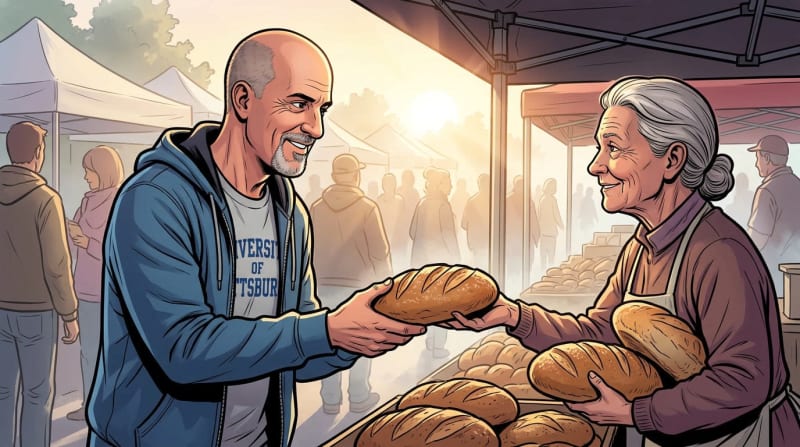
If you are coming to Palma, stay in the old city — Casc Antic, La Seu neighborhood, or the streets around the Llotja. Find an Airbnb with a kitchen. Walk to the Mercat de l'Olivar or the nearest neighborhood market the first morning and buy breakfast. Don't rent a car for the city portion — there's nowhere to put it and you'll see less.
The logic of slow travel is simple: when you cook in an apartment and walk to a grocery store, you start to see the same people. You learn where the good bread is. You find the plaza that's quiet at 8am. You stop being a visitor moving through a set piece and start being someone who temporarily lives somewhere. Palma makes this remarkably easy.
The cathedral will still be there on day four. So will the alley you haven't found yet. That's worth something.
Content ID: IblFIZvT7Lv3A4a0xiKuhmCu
See an error? Tell us.

Comments
Share with the Community