The View From 30,000 Feet: What the Sargassum Crisis Looks Like Up Close
The Short Version
- The Great Atlantic Sargassum Belt now stretches more than 8,800 kilometers from West Africa to the Gulf of Mexico, and by February 2026 its biomass was running more than 75 percent above historical averages for that time of year.
- Fresh sargassum on the beach is not immediately dangerous, but after roughly 48 hours of decomposition it releases hydrogen sulfide gas — a compound linked to neurological symptoms, and one that sent more than 11,400 people in Martinique and Guadeloupe to doctors in a single year.
- What researchers are calling a 'regime shift' matters more than any single bad season — this is less a temporary spike than a fundamental transition to a macroalgae-rich ocean that will likely define Caribbean coastlines for decades.
- Cleanup costs in the hardest-hit areas reach as much as $1.1 million per kilometer of beach per year, and total annual costs across the Caribbean have been estimated to exceed $120 million.
- The difference between a manageable nuisance and a public health event comes down almost entirely to whether crews are clearing the mats before that 48-hour decomposition window opens — well-staffed resort beaches and unmanaged ones are not experiencing the same crisis.
The View From 30,000 Feet
The View From 30,000 Feet
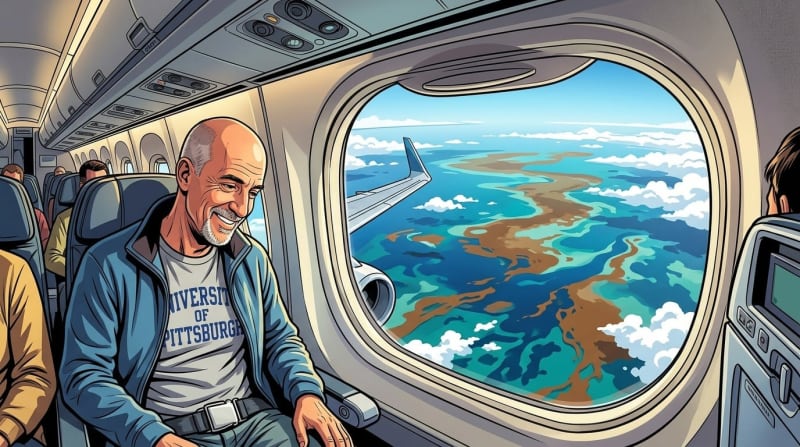
Flying in from Toronto on approach to St. Martin, I noticed something out the window I could not quite place at first. Long rust-colored streaks on the water below — teardrop shapes and windrows drifting with the wind, stretching for what looked like miles. From altitude they were actually beautiful. Organic, almost painterly against the deep blue. It took a moment to register what I was looking at.
By the time I was standing on Orient Bay the next morning, I understood.
Researchers who track sargassum from space describe exactly what I was seeing. The mats form a distinctive teardrop shape, rounded at the windward edge, trailing off in long stripes that are clearly visible in optical satellite imagery. What looks like abstract brushwork from a plane window is one of the largest biological phenomena on earth — the Great Atlantic Sargassum Belt, a floating mass of brown algae that stretches more than 8,800 kilometers from the coast of West Africa to the Gulf of Mexico. In 2026, it is larger and more active than it has ever been.
On the Ground at Orient Bay
On the Ground at Orient Bay
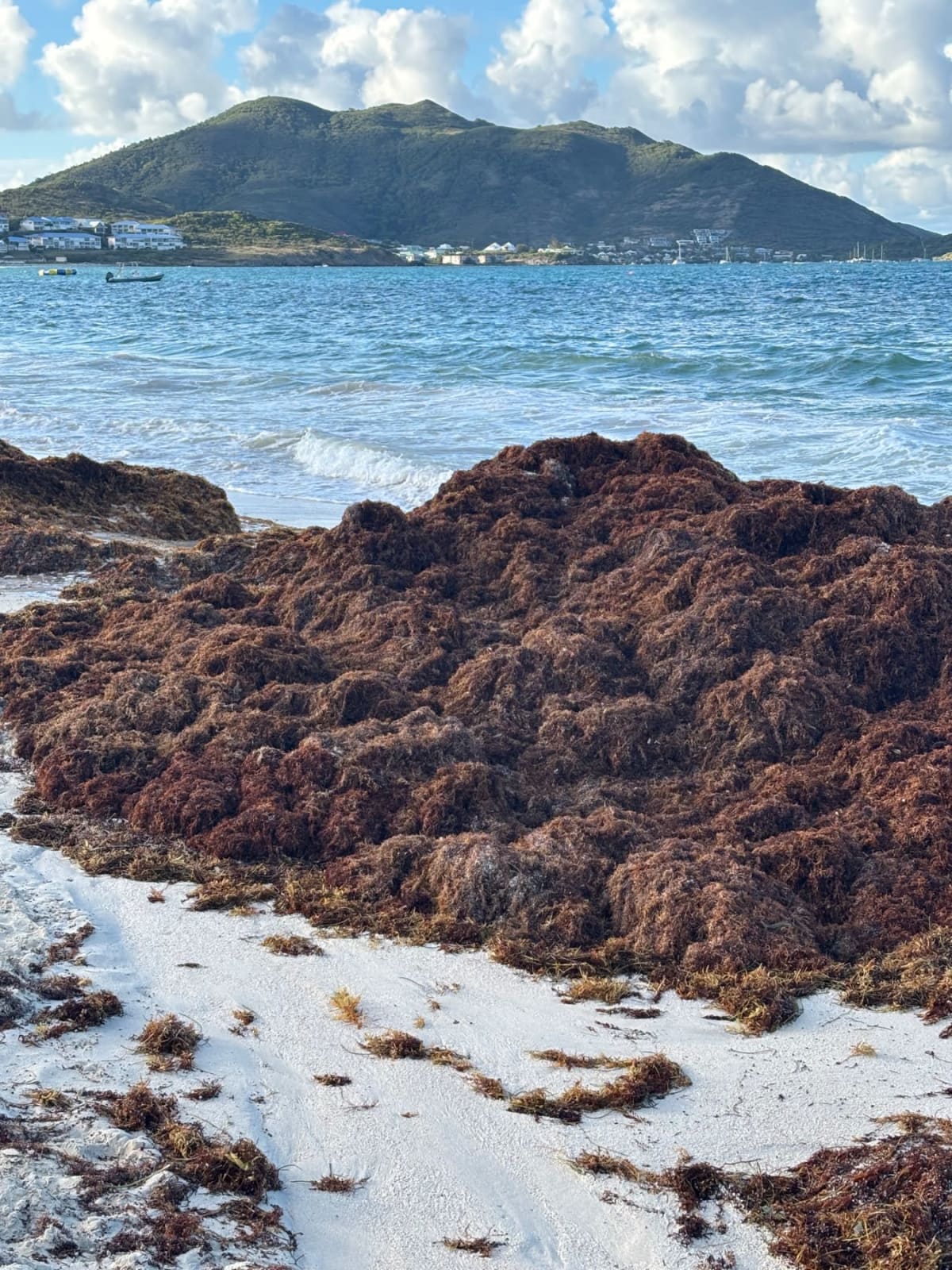
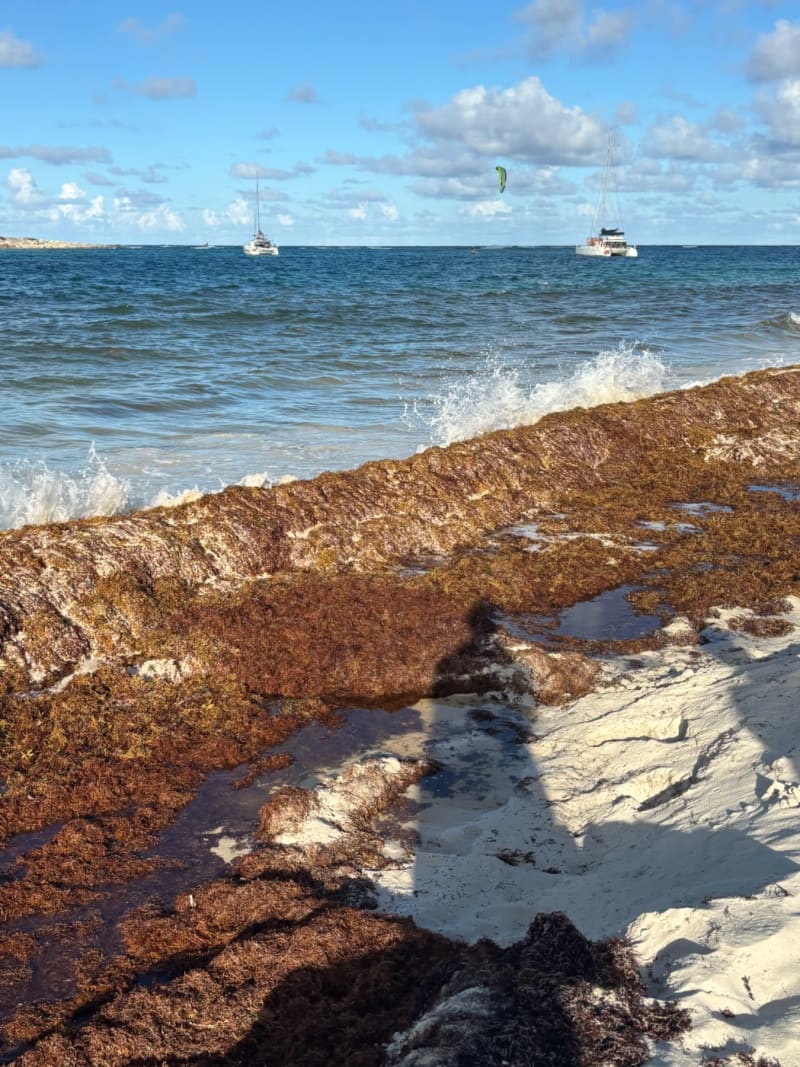
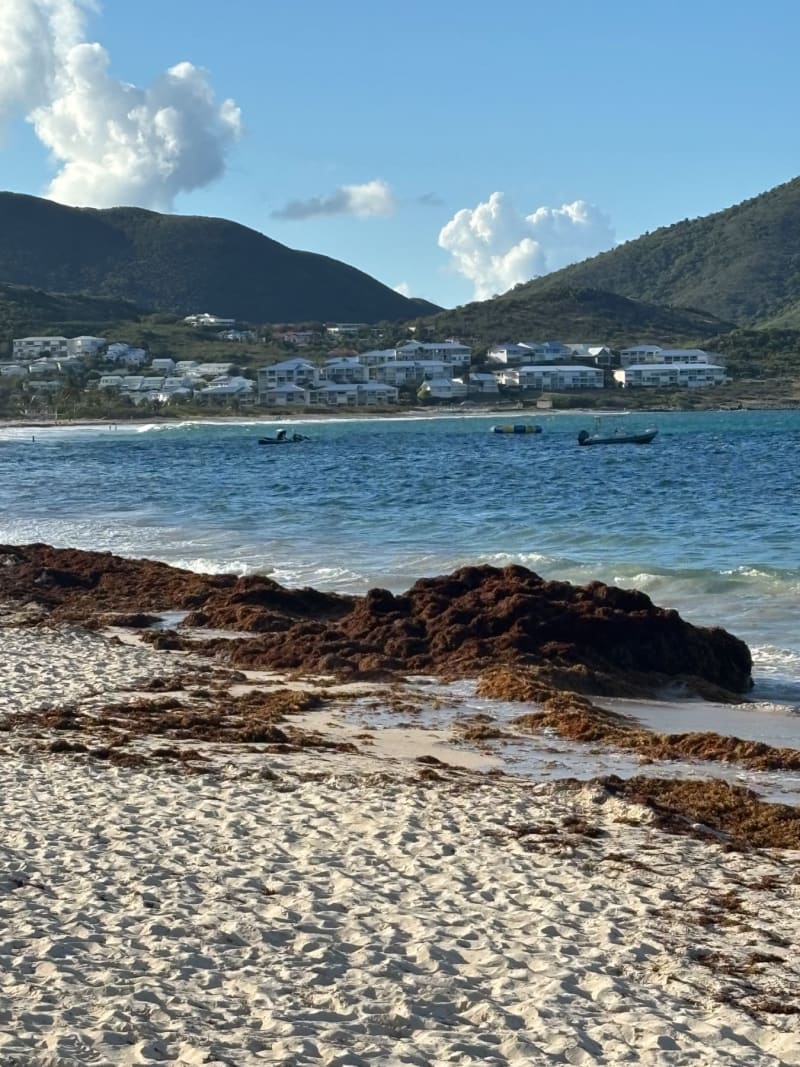
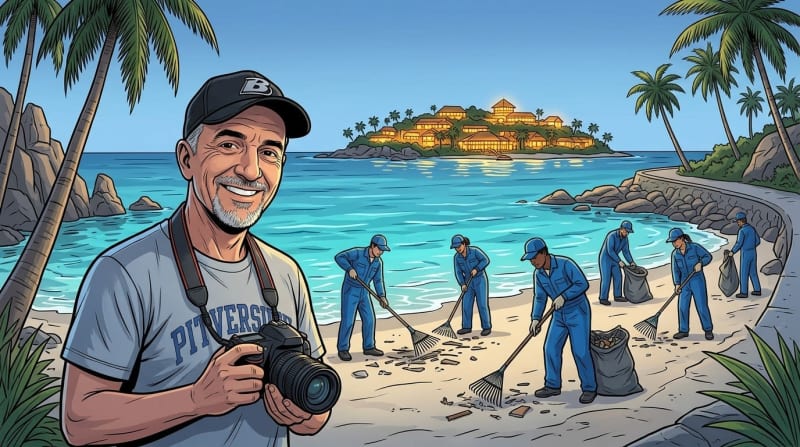
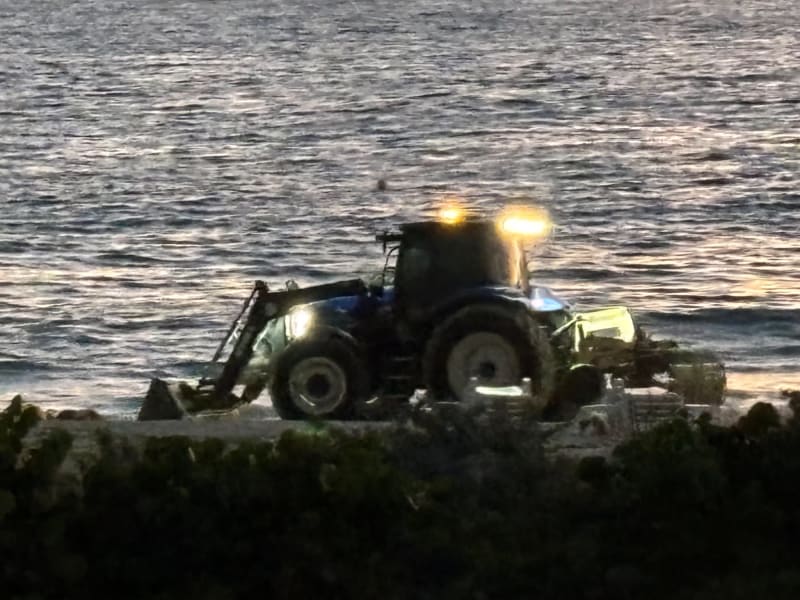
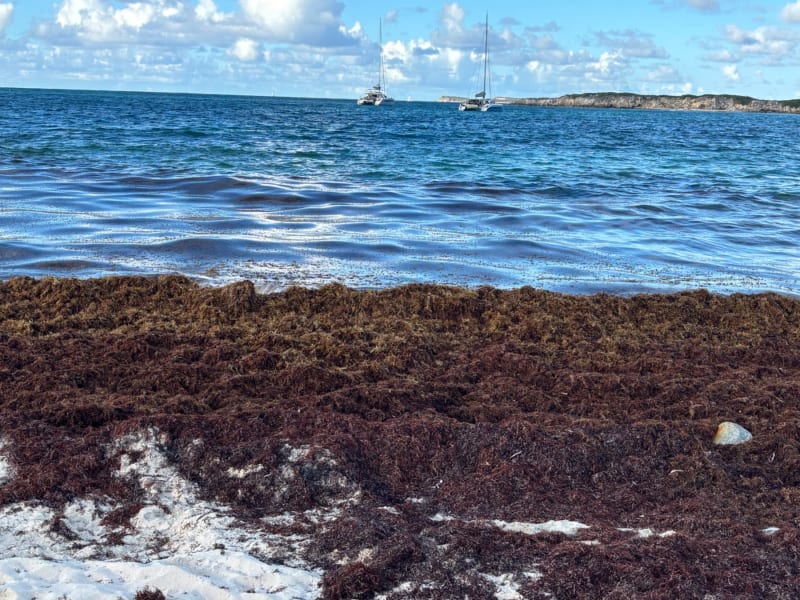
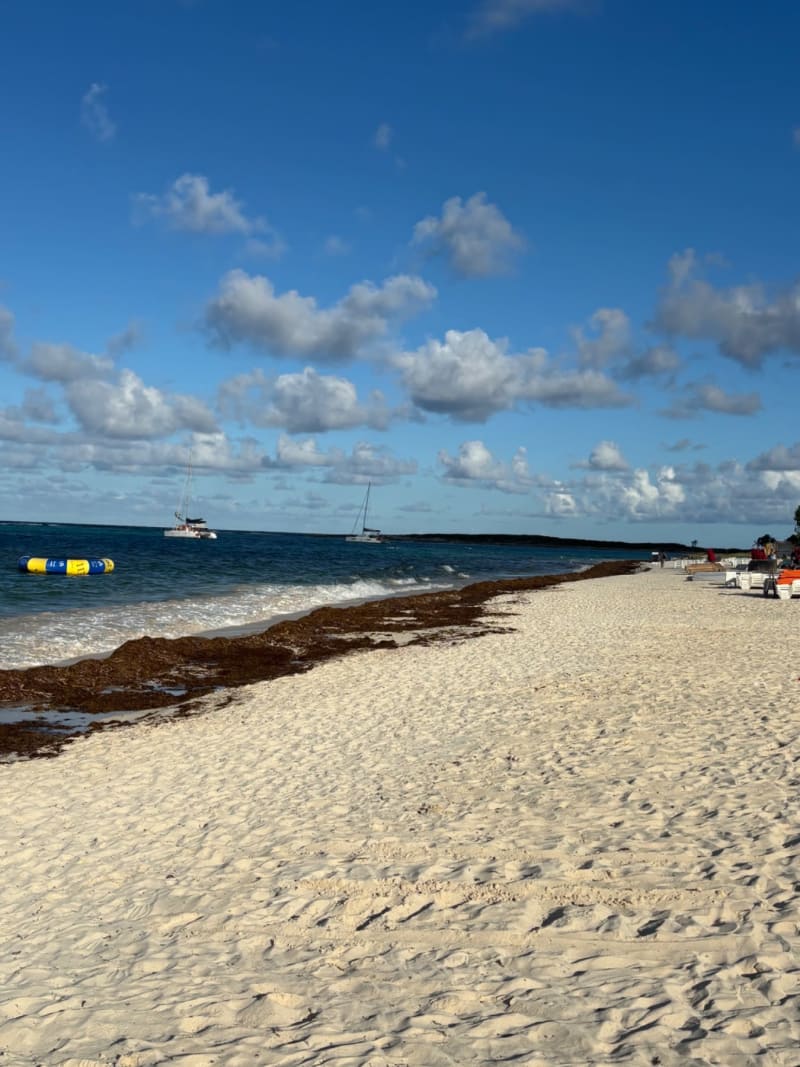
The beach looks like it lost an argument with the ocean. A thick mat of brown sargassum lines the shore — not a fringe, a wall. Cleanup crews were out before dawn moving it with heavy equipment. By mid-morning they had made a dent. The water itself clears up after the first ten feet. Once you are past that initial fringe, it is the same brilliant turquoise it always is.
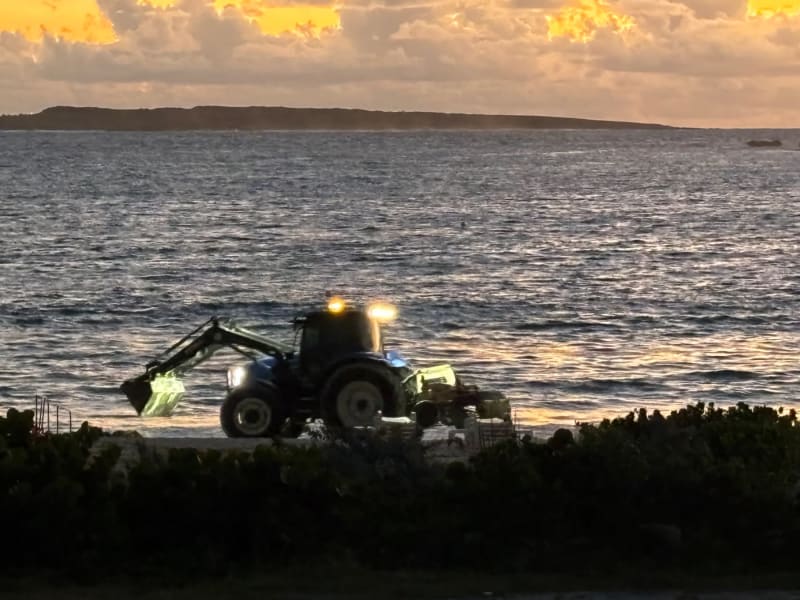
The smell is not bad. Not yet. The wind has shifted and pushed most of it onto the sand rather than holding it in the water. We spent time in the ocean. It was fine past that first fringe. Calling it a minor nuisance is accurate — today. But conditions here can change in 48 hours depending on what the wind does, and what is a manageable inconvenience on a well-staffed resort beach can become something considerably worse on a beach with no cleanup crew. The difference between Orient Bay right now and some of the scenes coming out of other parts of the Caribbean this season is largely a function of resources and response time.
I have been coming to the Caribbean for years. I have never seen quantities like this.
A Golden Floating Rainforest
A Golden Floating Rainforest
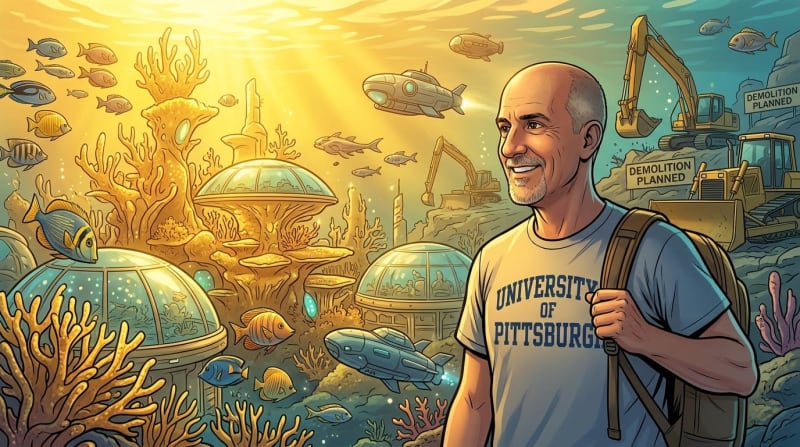
Before it becomes a problem, sargassum is a remarkable thing. In open water it forms what scientists describe as a golden floating rainforest — vast island-like masses sustained by gas-filled bladders that keep it buoyant, hosting hundreds of species of fish, invertebrates, crabs, and juvenile sea turtles that shelter and feed in its tangled structure. It has been part of the Atlantic ecosystem since at least the 15th century, when Christopher Columbus recorded floating mats of it in his logs crossing the Sargasso Sea.
The problem is not sargassum. The problem is sargassum in the wrong place, in quantities no coastal ecosystem was built to absorb. When it arrives on shore in the volumes we are seeing in 2026, the same organism that supports an entire open-ocean food web begins to smother coral reefs, deplete oxygen in nearshore waters, and trap wildlife — including dolphins, which can become fatally entangled in the mats. It clogs the water intake pipes of desalination plants and power stations. And as it decomposes on the beach, it becomes something else entirely.
2011: The Tipping Point
2011: The Tipping Point
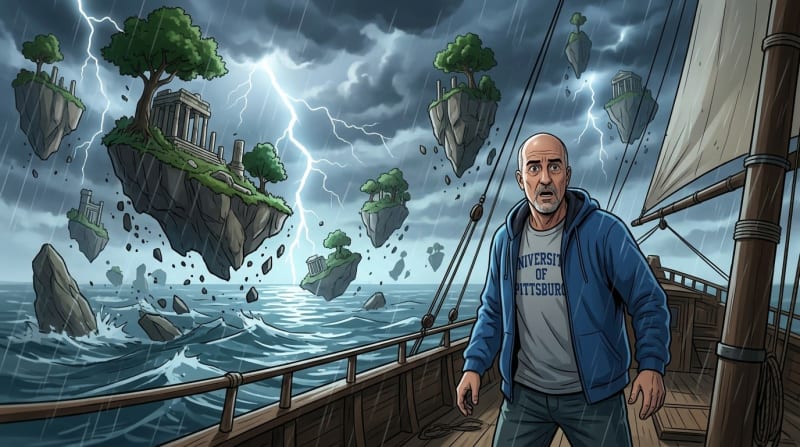
For most of recorded history, the Sargasso Sea — that vast gyre northeast of the Caribbean — kept sargassum largely in place. Small amounts drifted into the wider Atlantic, but never in quantities that threatened coastlines. Then something changed.
In 2009 and 2010, a rare atmospheric event called a strong negative North Atlantic Oscillation shifted wind patterns and ocean currents across the Atlantic in an unusual way. Patches of sargassum were swept from their historic home in the Sargasso Sea southward into the tropical Atlantic — a zone of warm water and deep, nutrient-rich upwellings that the algae had rarely encountered before. The conditions were perfect for explosive growth. The sargassum that arrived found light, warmth, and nutrients and simply did not stop. By 2011, satellite imagery captured the first massive bloom in the central Atlantic outside the Sargasso Sea. It has returned every year since, except 2013, growing larger and arriving earlier each time.
Scientists describe what happened as an environmental tipping point — less a single catastrophic event than an amplification of conditions already present in the system. A population of algae found itself in a new and fertile zone and established a self-sustaining cycle that has proven impossible to reverse. The Great Atlantic Sargassum Belt, as researchers now call it, has since become the largest macroalgae bloom in the world.
Is This Really the Worst Ever?
Is This Really the Worst Ever?
That is the claim circulating in travel media right now, and the honest answer is: almost.
Scientists at the University of South Florida Optical Oceanography Lab — the global standard for sargassum tracking — confirmed that 2025 was the worst year on record, with an estimated 38 million metric tons floating across the Atlantic, the Caribbean Sea, and the Gulf of Mexico. That broke the previous record set in 2022 by 58 percent. What researchers are now saying about 2026 is that it may be worse still. The bloom is forming earlier and in greater volumes than the record year. By February, sargassum biomass was running more than 75 percent above historical averages for that time of year. St. Martin Nature Foundation has warned that heavy landings are likely to continue through September.
So: not definitively the worst ever yet. We are only in April, and the season typically peaks in June and July. The trajectory is not encouraging.
What Is Driving It
What Is Driving It
The science here is still developing, but the broad outlines are clear. The Great Atlantic Sargassum Belt is fed by nutrient-rich upwellings from the deep ocean — vertical mixing that brings colder, more fertile water to the surface where the algae can photosynthesize and grow. River systems including the Amazon, the Orinoco, and the Mississippi contribute additional nutrients as they discharge into the Atlantic. Warming ocean temperatures, which extend the growing season and accelerate the algae metabolism, compound both effects.
All of these factors are being intensified by climate change. Warmer oceans, altered wind patterns, more extreme precipitation events that flush larger nutrient loads into the sea — each one pushes the belt further and makes the seasonal blooms larger. One researcher at the University of South Florida described what we are witnessing as a regime shift: a fundamental transition from a macroalgae-poor ocean to a macroalgae-rich one. That framing matters. This is not a bad season. It is a new baseline that will likely define Caribbean coastlines for decades.
What It Means for Human Health
What It Means for Human Health
Here is something most travel coverage gets wrong about sargassum: the health risks are real, but they are not immediate. Fresh sargassum on the beach is not toxic. The danger clock starts at roughly 48 hours after it washes ashore, when decomposition begins producing hydrogen sulfide gas — the compound responsible for the rotten-egg smell that signals serious accumulation. At low concentrations it causes headache, nausea, and eye irritation. At higher concentrations it produces vertigo, confusion, memory loss, and respiratory distress. Prolonged exposure at significant levels has been linked to neurological symptoms, particularly in children, the elderly, and people with existing respiratory conditions.
The numbers from the worst events are sobering. In 2018, doctors in Martinique and Guadeloupe reported more than 11,400 cases of acute hydrogen sulfide exposure from decomposing sargassum in a single year. Researchers have also found that sargassum accumulates arsenic and other heavy metals from seawater during its open-ocean drift, raising concerns about seafood safety in heavily affected coastal areas.
At Orient Bay this morning, there is no smell. The crews are clearing the mats before the 48-hour window opens. That is not a small thing. The difference between the manageable nuisance I am experiencing and the public health events documented in Martinique is largely a function of whether beaches are staffed and cleared quickly enough. On a well-managed resort beach with early-morning crews, the risk stays low. On an unmanaged beach where sargassum sits for days in the heat, the story changes.
The Economic Toll
The Economic Toll
For the Caribbean as a whole, sargassum has moved from a seasonal inconvenience to a structural economic threat. Tourism accounts for roughly 20 percent of GDP across most Caribbean island nations. Research across 30 Caribbean small island states found that an average sargassum event reduces tourist arrival growth by 1.1 percentage points for up to eight months after a bloom — with the worst events causing reductions of up to 9 percentage points. Hotel occupancy in the Mexican Caribbean fell 2.9 percent during the 2018 event alone.
The cleanup costs are staggering. In Quintana Roo, Mexico, removal operations are estimated to cost as much as $1.1 million per kilometer of beach per year. Across the most severely affected areas of the Caribbean, total annual cleanup costs have been estimated to exceed $120 million. In 2025, Dominican President Luis Abinader addressed the United Nations Ocean Conference directly, warning that sargassum could deal a significant blow to the GDP of island nations. It was an unusual moment — a head of state at the UN, talking about seaweed. It reflected how far the crisis has escalated.
What Is Being Done
What Is Being Done
The response across the region has intensified, with varying results.
Mexico has deployed naval vessels offshore to intercept sargassum before it reaches beaches, invested in barrier systems along the Riviera Maya, and launched a pilot biofuel program to convert collected seaweed into biogas and bioethanol. The goal for 2026 is to stop 80 percent of sargassum at sea before it reaches shore — ambitious given that 2025 cleanup collected nearly 93,000 tons from Mexican beaches alone.
On St. Martin, the Collectivity has established collection and processing protocols, identified temporary storage sites, and is working with the Saint-Martin Nature Reserve to manage disposal in ways that protect the island fragile aquifer. Researchers at Columbia University Lamont-Doherty Earth Observatory are studying the feasibility of deep-sea sequestration — trapping sargassum offshore and sinking it to depths of 2,000 meters where it could store carbon rather than decompose on a beach.
None of these are permanent solutions. The scale of the belt consistently outpaces the resources available to small island governments working largely without international funding. The Dominican president UN speech was partly a plea for exactly that — recognition that this is a transboundary crisis requiring a coordinated response, not a local problem for each island to absorb alone.
What Travelers Need to Know
What Travelers Need to Know
If you are planning a trip to St. Martin or anywhere in the Caribbean this season, a few honest observations from someone standing on Orient Bay right now.
Check conditions close to your travel date, not six weeks out. Sargassum moves with wind and current and can shift dramatically in 48 hours in either direction. A beach that is buried one day can be clear the next. The reverse is also true. The University of South Florida Sargassum Watch System publishes monthly bulletins and near real-time satellite imagery that are freely accessible and far more reliable than travel blog snapshots.
Beach choice matters. Orient Bay is Atlantic-facing and takes more direct exposure than a protected bay on the leeward side of the island. On French Saint-Martin, areas like Grand Case and Marigot Bay on the western coast are naturally more sheltered. Knowing which direction your beach faces is genuinely useful information before you book.
Well-managed beaches at active resorts are cleaned daily, often before sunrise. What you see in the dramatic photographs circulating on social media is often the pre-cleanup reality, not what the beach looks like at noon.
The water is still beautiful. Past the first few feet of shoreline fringe, the Caribbean is doing exactly what it always does. The clarity, the color, the warmth — it is all still there. Sargassum is a serious environmental story and an escalating crisis for the communities that live here. It is not a verdict on this place.
Orient Bay is worth it. It was worth it this morning, seaweed wall and all.
Content ID: 80zjTnpGBZWbQ9x9rWYn4hND
See an error? Tell us.
Comments
Share with the Community