
What Cleveland Gets Right (And What Rochester Should Be Watching)
The Short Version
- Cleveland's downtown population has surpassed pre-pandemic levels by 12%, hitting 21,000 residents, with projections toward 29,000 by 2032 — numbers that didn't appear by accident but through decades of focused, aligned public and private investment.
- The Heinen's grocery store inside the 1907 Cleveland Trust Company Building — a neoclassical rotunda with a stained-glass dome and murals painted by a man who went down with the Titanic — is the clearest single argument for converting old buildings rather than tearing them down.
- Playhouse Square is the largest performing arts center in the US outside of New York City, and Cleveland's Broadway season ticket holder base of more than 45,000 is the biggest in the country — facts most people, including many Clevelanders, don't know.
- Cleveland leads the nation in converting vacant office buildings to residential and mixed-use spaces, and the concentration of that effort around a compact area like Public Square is what turned a ghost town into a functioning neighborhood across all hours of the day.
- Rochester has the same bones, the same Great Lakes waterfront, the same post-industrial architecture, and the same civic stubbornness — the open question is whether it will organize around what it already has before someone else writes the headline about a different city.
We didn't plan a trip to Cleveland. We planned a trip to a swim meet.
Our son was competing in a D1 meet at Cleveland State University, and Renee and I drove down with our daughter to watch. We booked an Airbnb a few blocks from campus — a restored apartment in one of those old downtown buildings that still has the bones of something grand — and figured we'd spend a couple days cheering at the pool and maybe find a decent place for dinner.
What we didn't plan on was Cleveland itself.
I've been to the city before, in passing, the way you pass through a place without really seeing it. But this time we were planted in the middle of it for a few days, on foot, in a neighborhood that is visibly in the middle of becoming something. And I couldn't stop making comparisons to Rochester. The same bones. Some of the same scars. And somewhere in the difference between how these two cities are approaching the same problem — there's something worth paying attention to.
We Came for a Swim Meet

We Came for a Swim Meet
Cleveland State University sits at the eastern edge of downtown, anchoring what's officially called the Campus District — a 500-acre stretch of urban neighborhood defined by three institutions: CSU, Cuyahoga Community College, and St. Vincent Charity Medical Center. From our Airbnb window on the first morning, the view stretched over the rooftops of the campus toward Lake Erie on the horizon, the water catching the early light behind a row of industrial smokestacks. It was one of those views that tells you immediately you're in a serious city.
CSU itself is a school in the middle of reinventing its relationship with the place it lives. The campus was originally planned in the 1960s as an inward-turning mass of buildings, with a tendency to keep the city at arm's length that was reinforced in subsequent plans as recently as the mid-1990s. Now the university is working through a $650 million, 10-year master plan that includes a new 5,000 to 7,000-seat multi-purpose arena, expanded student housing, and three new districts — Academic Core, Student Residential Experience, and Partnership District. The goal, as CSU President Laura Bloomberg has put it, is for the university to serve as a catalyst for growth for the city and the region — not just a school that happens to be located downtown, but an anchor institution that pulls the neighborhood forward with it.
That's a different posture. And you can feel it in the neighborhood around the campus — the new residential buildings going up, the foot traffic on streets that weren't designed for it, the sense that the edges of campus and the edges of the city are starting to blur in ways that feel intentional.
We were there for the swim meet. But walking those blocks each morning and evening, I kept thinking: this is what it looks like when a university decides it has an obligation to its city.
A City That Decided to Believe in Itself

A City That Decided to Believe in Itself
Rochester and Cleveland are the same story told at different tempos. Both were industrial powerhouses. Both took brutal hits when that industry left. Both have the architecture of ambition — grand civic buildings, wide boulevards, Beaux-Arts facades — sitting alongside the evidence of decades of disinvestment. Both have the bones.
The difference, walking downtown Cleveland in the late fall, is that Cleveland seems to have made a decision about its bones.
The Washington Post called Cleveland "America's best example of turning around a dying downtown," and while that's the kind of headline that generates local pride and national skepticism in equal measure, the data underneath it is hard to argue with. Downtown Cleveland's population has exceeded pre-pandemic levels by 12%, reaching 21,000 — with projections pointing toward 29,000 by 2032, supported by an additional 6,500 residential units. More striking: Cleveland leads the nation in conversions of old office buildings into multi-use and residential spaces, according to CBRE. The former mayor Frank Jackson described downtown at the start of his tenure in 2006 this way: you could roll a bowling ball downtown after work and not hit anybody. It was a ghost town.
What changed? A combination of things, but the clearest answer is focus. The key to Cleveland's success was concentrating transformation efforts on a compact area around Public Square. The 2016 renovation — accelerated to finish before Cleveland hosted the Republican National Convention — became the catalyst. Apartments immediately surrounding the square increased from roughly 40 in 2016 to more than 1,200 now. When those conversions happen in a concentrated area, they don't just add housing — they shift the identity of a neighborhood from a 9-to-5 office district to something that functions across the full hours of a day.
Cleveland has been particularly successful at securing state and federal historic preservation tax credits, and the results are visible everywhere you walk. Buildings that sat vacant for decades are now hotels, apartments, grocery stores, restaurants. The city has 10 nationally designated historic districts, which isn't just a preservation achievement — it's an economic strategy. You don't demolish what you can convert. You don't build new what you can restore.
Rochester, of course, knows all of this in theory. The question is what it looks like when a city commits to it at scale, over decades, with aligned public and private leadership. Cleveland is the answer to that question. Imperfect, unfinished, still carrying deep inequities — Cleveland remains one of the poorest big cities in America, and any honest accounting of the revival has to hold that alongside the success — but pointing somewhere.
What does it feel like when a city decides to believe in what it already has?
Walking Euclid Avenue
Walking Euclid Avenue
We walked a lot. That's how you actually learn a city.
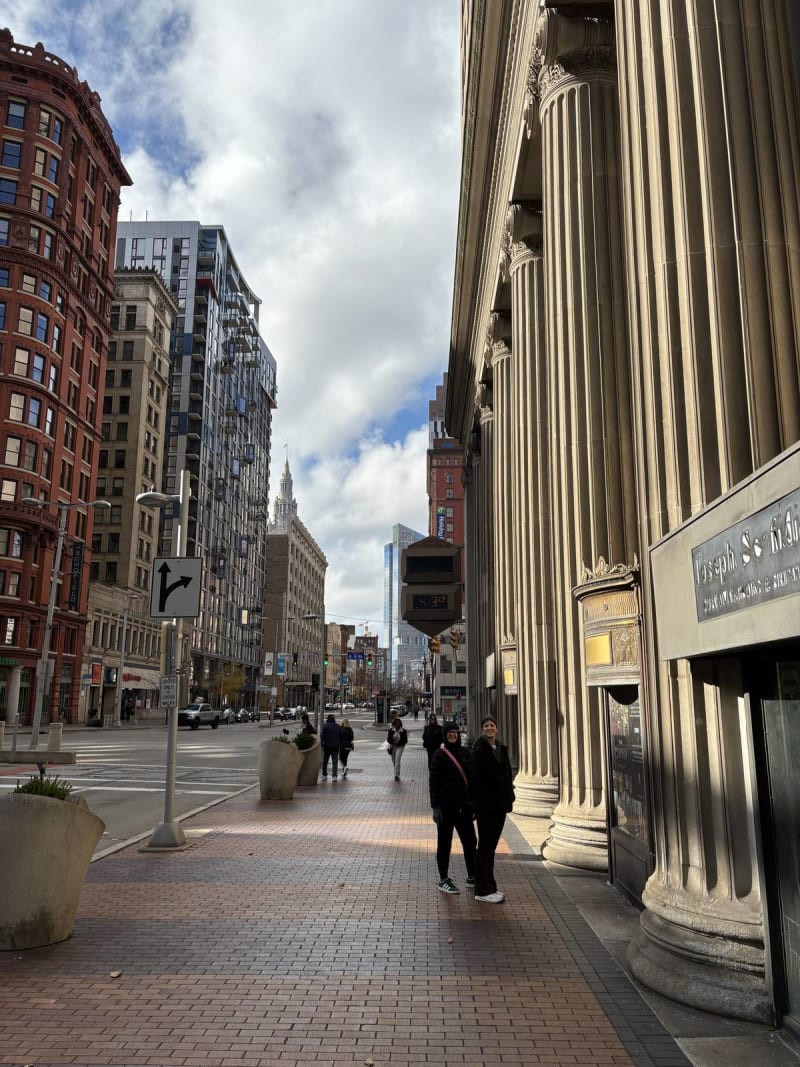
Euclid Avenue runs east from Public Square through downtown toward the university and Playhouse Square, and it does something that not every urban street manages to do: it keeps surprising you. One block you're passing a glass tower. The next, a 1908 Beaux-Arts facade that looks like it was dropped in from another century. The mix doesn't feel accidental. It feels like a city that has decided to keep its layers rather than sand them down to a single aesthetic.
The moment that stopped me cold was Heinen's grocery store. From the outside, it looks like what it once was — the 1907 Cleveland Trust Company Building, designed by architect George B. Post and located at the corner of East 9th Street and Euclid Avenue. Neoclassical columns, stone pediment, the full architectural authority of an institution that built things to last. You walk in expecting a bank lobby and you find produce. The building sat mothballed for over 20 years after the last bank merger caused the rotunda to close to the public in 1996. In 2014, Geis Companies purchased the landmark and set to work on rehabilitation — choosing Heinen's Fine Foods to anchor the complex, restoring the original three-story rotunda with its stained-glass domed ceiling and hand-painted murals.
The result is remarkable in a way that's hard to describe without sounding like you're overselling a grocery store. But this isn't really about a grocery store. It's about what a city signals when it says: this building is worth saving, this neighborhood is worth feeding, this history is worth carrying forward. The building was designed by George Post five years after he designed the New York Stock Exchange, and the man who painted the murals went down with the Titanic. You're buying your coffee under that ceiling. That's not nothing.
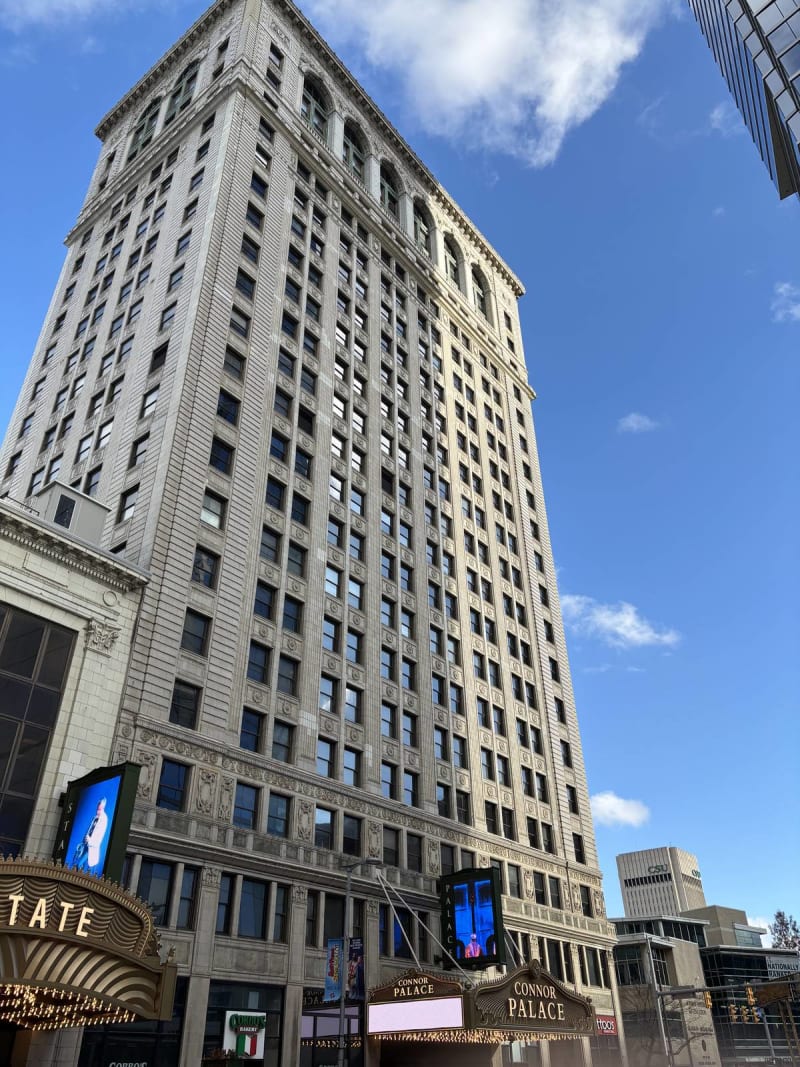
A few blocks west, Playhouse Square. It is the largest performing arts center in the US outside of New York City — only Lincoln Center is larger. Five historic theaters built in a 19-month span in the early 1920s, nearly lost to the wrecking ball in the 1970s, revived through a grassroots effort that locals still describe as one of the top ten achievements in Cleveland history. The Connor Palace — the building reaching skyward with all those ornate Beaux-Arts floors — opened in November 1922 as the Palace Theatre, billed as the "Showplace of the World." Today it hosts Broadway touring productions. Cleveland's season ticket holder base for Broadway is the largest in the country — more than 45,000 — making it one of fewer than 10 markets that can support a three-week run of a touring show.
People don't know this about Cleveland. Cleveland doesn't seem particularly concerned about whether people know it or not. The city is just going about the work.
The Rock & Roll Hall of Fame

The Rock & Roll Hall of Fame
I'll admit I didn't know what to expect from the building itself.
I knew it was I.M. Pei. I knew it was on the lake. But the photos don't prepare you for the actual experience of walking up to it — the glass pyramid rising against a gray Lake Erie sky, the red ROCK letters out front, the scale of it sitting at the edge of the water like it was placed there by someone who understood that some buildings need to be seen from a distance and others need to pull you in. This one does both.
We were there on a cool fall day — Renee, our daughter, and me — and the construction fencing around the western side of the building was impossible to miss. That's the expansion. Museum officials raised $135 million for the project — well above the initial $100 million target — almost entirely from private donors. The expansion will grow the Rock Hall from 155,000 to 205,000 square feet, adding a 10,000-square-foot gallery for large traveling exhibits, a state-of-the-art education center, and a concert facility that can hold nearly 3,000 people. The completion date is mid-2026. Standing there with the scaffolding behind us, it felt appropriate — a city and an institution both mid-construction, both becoming something.
The Rock Hall is what happens when a community decides that culture is infrastructure. Cleveland fought for this building. The museum has had 14 million guests and a $2 billion economic impact on the region since opening in 1995. Those numbers matter, but they're not really why the building matters. It matters because it tells everyone who arrives on that lakefront that this city has a story worth telling. That the music that changed the 20th century passed through here, grew here, was named here. That belonging to that story is something Cleveland claims, not something it waits to be given.
What would it feel like to walk up to something like this in Rochester?
Inside the Hall

Inside the Hall
You could spend a full day inside and not see everything, and that's before the expansion opens.
The first thing that gets you is the scale of the atrium — the glass pyramid from the outside becomes this soaring interior space with Lake Erie visible through the walls, light shifting with the clouds off the water. Suspended in that space, filling it entirely, is the Roger Waters installation from The Wall — figures suspended mid-climb, mid-fall, the staircase of blocks written over with Waters' own handwriting from 1995. It stops you. You're looking at a rock album turned into a three-dimensional object hanging above an inland sea, and somehow it makes complete sense.
On the main floor, the CBGB awning. The actual awning — 315 Bowery, the white canvas with the red lettering, pulled from the doorway of the New York club where punk was born and installed here in Cleveland under a hanging plane, next to escalators and red-and-black graphic walls covered in album art. You walk under it and you feel, for a moment, like you're standing at the corner where everything changed.
The curatorial decisions throughout the building reflect a real philosophy about what this place is for. It's not a museum that puts things behind glass and asks you to be quiet. It's a museum that puts things in your way — artifacts that interrupt your path, sounds that arrive from unexpected directions, stories that don't resolve neatly. The Wall installation, in particular, is doing something subtle: it's not celebrating Roger Waters. It's presenting a moment of private crisis — the journal entry visible on the blocks, the figures caught in the moment of a decision — and asking visitors to sit with it. That's the gift of belonging before resolution. You don't have to have answers to be here. You just have to have listened.
We stayed longer than we planned. That's usually a good sign.
What a City Believes About Itself
What a City Believes About Itself
Rochester and Cleveland are separated by about four hours on the Thruway. They sit on different Great Lakes — Rochester on Ontario, Cleveland on Erie — but they share the same industrial legacy, the same post-manufacturing scars, and a particular kind of civic stubbornness that I've always found admirable — the refusal to be defined entirely by what was lost.
What Cleveland has figured out, I think, is something simpler and harder than a development strategy. It has decided to lead with its gifts rather than its deficiencies. The bones are gifts. The architecture is a gift. The lake is a gift. The music heritage is a gift. The university system is a gift. The Heinen's family deciding to open a grocery store in a 115-year-old rotunda rather than a strip mall — that's a gift. Downtown Cleveland is the fastest-growing neighborhood in the city, with 32% population growth since 2010 and more than $9 billion in investment transforming it into a diverse and thriving community. That growth didn't come from nowhere. It came from a community that decided what it already had was worth investing in.
The Washington Post piece, the national attention, the accolades — none of that is really the point. The point is what it feels like to walk those blocks at 7 in the morning, to see people walking dogs past a 1908 bank building, to watch students cut across a campus that is actively being stitched back into the city that surrounds it. The point is the swim meet, the Airbnb in the restored building, the long walk down Euclid Avenue with Renee and our daughter before the day's events began. The point is the question that stayed with me for the whole drive home.
What does a city become when it decides to believe in what it already has?
Cleveland isn't finished answering that. Neither is Rochester. But the question itself — the willingness to ask it out loud, to organize around it, to spend money and make decisions and convert the old bank into a grocery store rather than tear it down — that's where the work begins.
We came for a swim meet. We came home thinking about our own city differently. That's not a small thing.
Photos by Adam Stetzer. Visited fall 2024.
Content ID: X6byx5DcCioWEubPNBaJtpp1
See an error? Tell us.

Comments
Share with the Community