
Barcelona's Gothic Quarter: What Nobody Tells You Before You Go
The Short Version
- Four Corinthian columns from the Roman Temple of Augustus, nearly 2,000 years old, stand in a hidden courtyard off Carrer Paradís — most visitors walk right past the entrance and never see them.
- Els Quatre Gats café opened on 12 June 1897, and the poster on its door on Carrer Montsió is an original Picasso design — created when he was 17 years old, before anyone outside Barcelona knew his name.
- The Gothic Quarter looks medieval but most of its visible architecture dates from a neo-Gothic restoration project in 1929, built deliberately to evoke a romanticized version of the Middle Ages.
- Staying in the Eixample rather than the Gothic Quarter itself offers a real navigational advantage — the rational grid of octagonal intersections is easy to reset from after a long day in the medieval maze.
- The Caganer shop on Carrer de la Portaferrissa carries over 500 ceramic figurines rooted in a Catalan tradition dating to the late 17th century, and the tradition behind the figures — fertility, humility, the leveling of kings and celebrities — is more interesting than the joke first suggests.
Where You Stay Shapes Everything
Where You Stay Shapes Everything
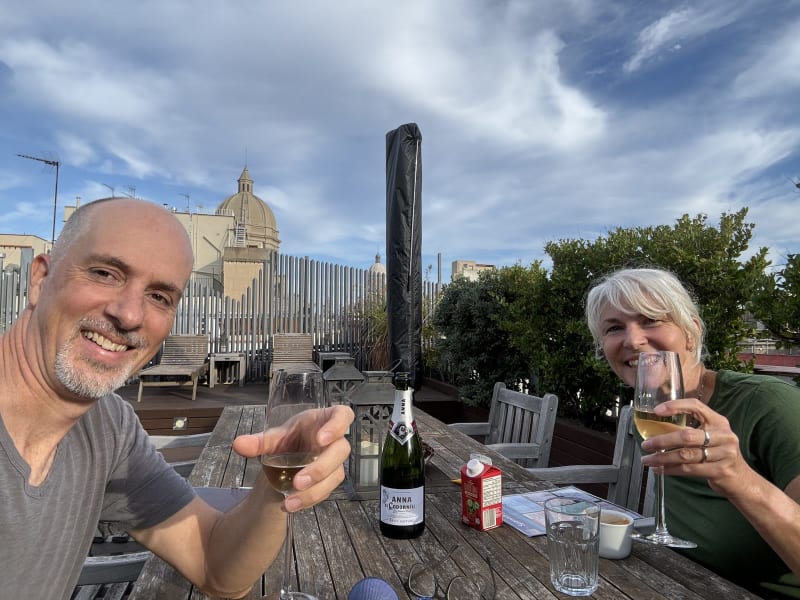
Most people planning a first trip to Barcelona spend a lot of time asking which neighborhood to stay in. It is the right question, and here is an honest answer from someone who has done it: we stayed just outside the Gothic Quarter, in the Eixample, near the Universitat metro stop at Carrer del Pelai. That turned out to be close to ideal — and if you are asking the same question, it is worth understanding why.
The Eixample is built on a rational grid of broad boulevards, octagonal intersections, and identical city blocks — all designed for light and legibility. The Gothic Quarter is the opposite. A walk through the Gothic Quarter is like a journey through time — the typical Roman grid plan is still visible in the quarter's layout, but only a few roads are open for car traffic, and the narrow, atmospheric streets require you to look up and around constantly or risk missing the best of it. Staying in the Eixample meant we could get our bearings in a neighborhood designed for humans to navigate, then dive into the Quarter each day without the disorientation of trying to find our way home at midnight through a medieval maze.

One of the best things about staying in the Eixample is how easy it is to get around — some areas are close enough to walk to the city center, and you will also be near La Sagrada Família. For us, the Gothic Quarter was a fifteen-minute walk. We went in every direction depending on what we wanted and always knew how to reset. That matters more than it sounds after a long day on cobblestones.
The Gothic Quarter has metro access at L3 Liceu, L4 Jaume I, and a short walk to L1, L2, and L3 at Universitat and Catalunya stations — so getting there from anywhere in the Eixample takes minutes. What neighborhood is right for you? If you want to wake up inside the historic maze, the Gothic Quarter itself delivers atmosphere from the moment you open your door. If you want a quieter, more navigable base with easy access to everything — including Gaudí's buildings, which are concentrated in the Eixample — staying near Universitat or Passeig de Gràcia is worth serious consideration. We would make the same choice again.
The Night the Plaza Woke Up

The Night the Plaza Woke Up
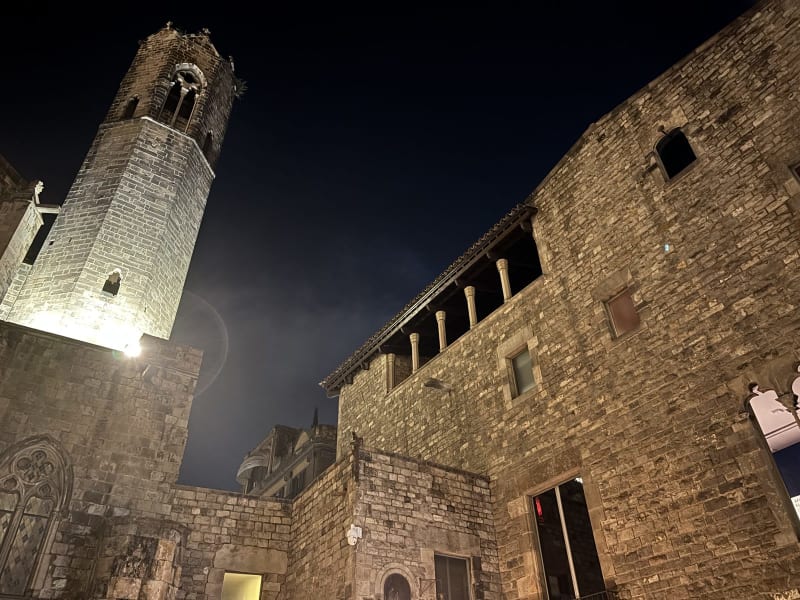
There is a particular quality of light in the Gothic Quarter after dark that photographs can barely capture. Stone walls that look dusty and beige in afternoon sun turn amber and gold under street lamps. Shadows sharpen into something almost architectural themselves. The narrow streets, which earlier in the day funnel tour groups from one monument to the next, start to feel like they belong to the people actually using them.
I took this photo somewhere around eleven o'clock on a Tuesday. The square was still full. Musicians, couples, small groups seated at café tables, a few people just standing and looking up at the buildings the way you do when a city surprises you. Early mornings and evenings offer the most peaceful version of the Gothic Quarter — midday brings the crowds, but those hours at the edges of the day belong to something different. Tuesday night at eleven felt like the city had been waiting all day to exhale.

The Gothic Quarter took on its characteristic Gothic style as grand churches, palaces, and plazas were built atop Roman foundations — Barcelona's most important civic and religious institutions all centered here for centuries. You feel that layered history most clearly at night, when the commercial noise drops and the scale of the architecture has room to land. The building visible in the plaza photo — its geometric diamond-pattern sgrafitto facade illuminated against the black sky — is one of the distinctive ornamental facades found around the Cathedral area. This district has been the center of political life in the city for over 2,000 years.
Standing in that square at eleven on a Tuesday, surrounded by people who were not in a hurry to be anywhere else, that claim did not feel like a line from a travel brochure. It felt like something you could actually sense. The best light in the Gothic Quarter is at golden hour and just after — crowds thin noticeably after 8:30 pm and the Quarter reveals a different version of itself.
If you visit Barcelona and only go to the Gothic Quarter during daylight hours, you are seeing half the place.
Dinner at Els Quatre Gats
Dinner at Els Quatre Gats
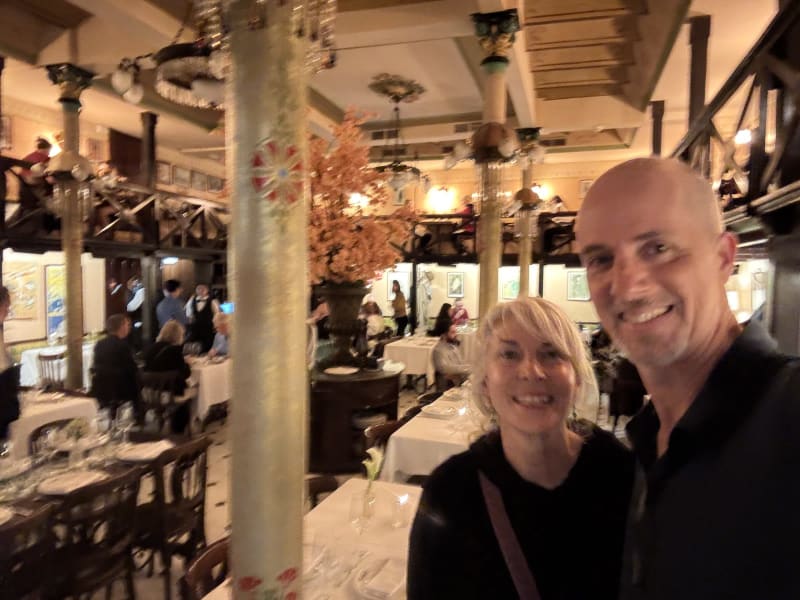
We did not plan dinner at Els Quatre Gats. We wandered in because the room stopped us cold.
The café opened on 12 June 1897 in the celebrated Casa Martí and served as a hostel, bar, and cabaret until it became a central meeting point for Barcelona's most prominent modernist figures — including Pablo Picasso, Antoni Gaudí, and Ramon Casas. The building itself, designed by architect Josep Puig i Cadafalch, sits on a quiet side street off the main shopping walkway — its medieval-style exterior invites you to step into an interior that was the meeting place for the intellectuals of modernist Barcelona at the end of the 19th century.
In 1899, a 17-year-old Picasso made his first individual exhibition of paintings at Els Quatre Gats and also created the image of the café's famous menu. The poster outside the door on Carrer Montsió is a Picasso design. That is not a reproduction hanging in a café to create atmosphere. That is the actual poster, in the actual spot where the actual young Picasso put it, over a century ago.
Inside, the place is warmly lit, finished in polished wood, and has a spacious upper balcony level overlooking the main floor. Multiple levels, painted columns, warm lamplight, white tablecloths, the kind of ceiling you stop mid-sentence to look at. It has the specific quality of a place that knows exactly what it is without performing it. There is a difference between a restaurant that has been turned into a museum and a restaurant that is still alive and happens to have tremendous history. Els Quatre Gats is the second kind.
Operating as a café, cabaret, and all-round artistic space between 1897 and 1903, Els Quatre Gats was a center of Modernista thought — hosting Picasso's first art exhibition and serving as the gathering point for the artistic avant-garde of Barcelona. It closed due to financial difficulties in 1903 and was restored and reopened decades later. The food is Catalan and Mediterranean — solid, not revelatory — but that is not why you go. You go because when you sit down at one of those white-tablecloth tables, you are sitting in the room where the Barcelona art scene used to argue about what was worth making. Gaudí was at these tables. Picasso was at these tables, as a teenager, before anyone outside Barcelona knew his name.
What would it mean to eat somewhere not for the food alone, but for what the room has witnessed?
The Caganer Shop Will Stop You Cold

The Caganer Shop Will Stop You Cold
I walked past the doorway twice before I understood what I was looking at.
The first, and only, shop in the world to exclusively sell Catalan caganers opened in Barcelona's Gothic Quarter — just off Carrer de Ferran. Outside the entrance stands a life-size version of the figure himself: pants down, a cheerful expression, entirely unbothered. The shop's mat reads "Spread Joy." Inside, shelves floor to ceiling hold hundreds of ceramic figurines — everyone from traditional Catalan farmers to sitting world leaders to cartoon characters, all in the same dignified squat.
The caganer is not a novelty item, and the tradition behind it is worth understanding before you laugh. The history of the caganer dates back to the late 17th century or early 18th century, during the Baroque period — in agricultural societies, the act of defecation symbolized fertility, and the figure was believed to fertilize the land, representing a promise of prosperity and good fortune in the coming year. The traditional figure appears in Catalan nativity scenes placed discreetly in the background — hidden from Mary, Joseph, and the baby Jesus — where children are invited to find him. It is a centuries-old family game embedded in Christmas tradition.
These figures symbolize humility, fertility, and the idea that everyone — even kings and celebrities — are fundamentally human. In 1992, a potter named Anna Maria Pla founded a shop specializing in caganer figurines and began expanding the collection to include versions of celebrities, politicians, rock stars, movie characters, and famous athletes — all depicted in the same posture. The Caganer shop now carries over 500 different figures and is located on Carrer de la Portaferrissa, 2, open daily.
What is remarkable about the caganer tradition is what it says about Catalan culture broadly: a willingness to hold the sacred and the irreverent in the same hand, to find something genuinely funny without cruelty, to insist that nobody — not the Pope, not the king, not the footballer — gets to be above the basic facts of being human. You will spend more time in there than you planned.
How Barcelona Reads as a City

How Barcelona Reads as a City
Before you find your way around Barcelona, the city teaches you its visual language — and learning to read it is part of what it means to actually arrive somewhere.
The glowing red cross — the Farmàcia sign — appears on almost every corner of the Eixample, its LED light visible from half a block away in any direction. The Estrella Damm umbrella over a café terrace. The ornate ironwork climbing a balcony facade, unchanged since the building went up over a century ago. Plane trees lining the wide Eixample boulevards, their dappled shade falling equally on everyone underneath. The Eixample holds the highest concentration of Gaudí buildings in Barcelona, its streets lined with upscale boutiques, restaurants, and architecture that stops you mid-stride — but the street-level language of the city is quieter than that. It is the everyday signs and textures that accumulate into something you start to recognize.
After a few days in Barcelona, you begin to read the place differently. You know that a narrow street opening suddenly into an unexpected square means you have wandered into the Gothic Quarter's interior. You know that a grid intersection with an octagonal cut corner is the Eixample's signature geometry, designed in the 19th century to let light into every building at every hour. Barcelona grew into a bustling port and capital of the Crown of Aragon during the Middle Ages, and the Gothic Quarter's grand churches, palaces, and plazas were built atop Roman foundations — but the city you walk through today layers more than just Roman and Gothic. It layers centuries of ordinary life. The pharmacy that has been on that corner since before anyone in the neighborhood can remember. The café terrace where people have been watching the street over coffee for generations. The red cross that tells you, in a city you don't yet know, that help is close by.
The Farmàcia sign is not picturesque. It does not appear on highlight lists or in travel magazines. But it is unmistakably, completely Barcelona — and noticing it, understanding what it is and why it is everywhere, is part of the shift from tourist to traveler. The city rewards that kind of attention.
What the Quarter Gives You When You Don't Plan Too Hard

What the Quarter Gives You When You Don't Plan Too Hard
The Gothic Quarter is one of the most visited neighborhoods in Europe. You will share it with many people. None of that should stop you.
Despite the name, most of the Gothic Quarter's visible architecture was built in the late 1800s through early 1900s in neo-Gothic style — in 1929, a massive restoration project aimed to recreate the feeling of medieval Barcelona, drawing on European neo-Gothic architecture to evoke a romanticized past. But the renovation is a thin layer on top of something far older. The Roman walls that surround the heart of Barcelona embrace Barcino, which existed from the 1st century BC — a city that began as a small colony and gradually grew into an imperial settlement. Four Corinthian columns from the Roman Temple of Augustus, nearly 2,000 years old, stand inside a courtyard off Carrer Paradís — hidden from view until you find the entrance and walk in, where they rise above you with an unexpected grandeur that stops conversation.
That is the Quarter at its best: the thing you weren't expecting, in the place you almost walked past. The squares that fill again after midnight. The restaurant where the young Picasso argued about painting. The shop selling a 300-year-old tradition in ceramic form, cheerfully, on a Tuesday afternoon. The pharmacy sign glowing red above a café terrace while someone reads a newspaper and nobody looks up.
One of the best ways to get to know the Gothic Quarter is simply to stroll and allow yourself to get a little lost — the quietest area of the district is found between Plaça Reial and the seafront, away from the cathedral crowds. Come without too firm a plan. Walk until something stops you. That has been, for two thousand years, the best way to see this place.
Content ID: Fj5AnFbzWMsyFyt9UOQ3MUDU
See an error? Tell us.


Comments
Share with the Community