Milos, Greece: The Island That Slows You Down
The Short Version
- Milos has been exporting obsidian — a volcanic glass prized for its sharpness — to Crete, the Peloponnese, and Anatolia since at least 15,000 BCE, making it a Mediterranean trade hub long before modern tourism existed.
- Sarakiniko beach is composed of pumice and volcanic tuff carved by wind and waves over millions of years, and the total absence of shade means the white rock reflects heat so intensely that serious sunscreen and water are non-negotiable.
- Klima's iconic boathouses were built out of hard practicality — fishermen carved storage directly into the soft volcanic rock and painted their doors the same color as their boats so they could identify their home from the water.
- At Paliochori beach, some restaurants use geothermal heat from the volcanic ground itself to cook food buried in the sand, connecting the meal directly to the geology underfoot.
- Fewer than 6,000 people live on this 151-square-kilometer island year-round, it has no international airport, and June or September give visitors weather close to peak season without the July and August crowds.
First Look: Arriving in Milos

First Look: Arriving in Milos
The ferry from Santorini takes just under two hours on the SeaJet — fast enough that the island appears before you've fully processed that you left. What comes into view first is the port of Adamas, white cubic buildings stepping back from the water, fishing boats at the dock, and a bay so blue it looks corrected in post. It doesn't need to be.
Milos sits at the southwestern edge of the Cyclades, roughly halfway between Athens and Crete. It's not the island everyone goes to — and that's exactly the point. According to Visit Greece, the island covers 151 square kilometers and has a year-round population of around 6,000. It has no international airport. The crowds that descend on Mykonos and Santorini largely haven't found it yet, though that's changing.
What they're finding is an island with a remarkable history underneath its beauty. Archaeologists have traced obsidian trade routes from Milos back to 15,000 BCE — this volcanic glass was sharp, durable, and valuable, and Milos was exporting it to Crete, the Peloponnese, and Anatolia long before the concept of tourism existed. The island was already connected to the Mediterranean world when most of the world was still figuring out agriculture. The Venus de Milo — now in the Louvre — was discovered here in 1820, near the village of Klima. A plaster cast lives in the Archaeological Museum in Plaka if you want to stand next to her on the island that made her.

What does it feel like to arrive somewhere that has been exporting beauty and resources for fifteen thousand years and still hasn't lost the plot? It feels like Milos.
Getting Here & Getting Around

Getting Here & Getting Around
We came in by ferry from Santorini on the SeaJet — which is fast. Very fast. The Seajets high-speed crossing from Santorini runs under two hours, and it moves like it means it. No complaints from us, but fair warning: wind is a real factor on Milos, and we watched the boat schedule shift more than once during our stay. If you're prone to seasickness, the calculus changes — Fast Ferries also runs the Santorini–Milos route with larger conventional vessels that take closer to five hours but ride considerably smoother. Book the biggest boat you can find if rough seas are a concern.
All ferries arrive at the port of Adamas on the northern side of the island, which is also the main town. The port is manageable, well-signed, and has ferry agency offices right on the waterfront. The main ferry companies serving Milos include Seajets, Blue Star Ferries, Fast Ferries, Minoan Lines, and Aegean Sea Lines. The most traveled route is from Piraeus (Athens), with the fastest high-speed crossings taking about two and a half hours. If you're island hopping, Milos connects easily to Paros, Santorini, Folegandros, Ios, Serifos, and Sifnos — it sits at a useful crossroads in the western Cyclades.

We flew out on a puddle jumper back to Athens — and I won't pretend the wind didn't make us nervous. The airport is tiny. The planes are small. Milos Island National Airport (MLO) connects directly to Athens with Aegean Airlines, Olympic Air, and Sky Express, with the flight clocking in around 40 minutes. It's convenient — but on a windy day you'll be refreshing the flight status more than you'd like. Ours went fine.
Once you're there, rent a car. Just do it. We picked one up easily in Adamas right in town. The island is compact — you can cross it in under an hour — but the beaches and villages are spread out enough that without wheels you're dependent on buses that don't always go where you want, when you want. Car rental shops are clustered near the port and the process was simple. The roads are narrow in places and the signage is Greek-first, but the island is small enough that getting lost is more adventure than disaster.

Sarakiniko: The Moon Beach

Sarakiniko: The Moon Beach
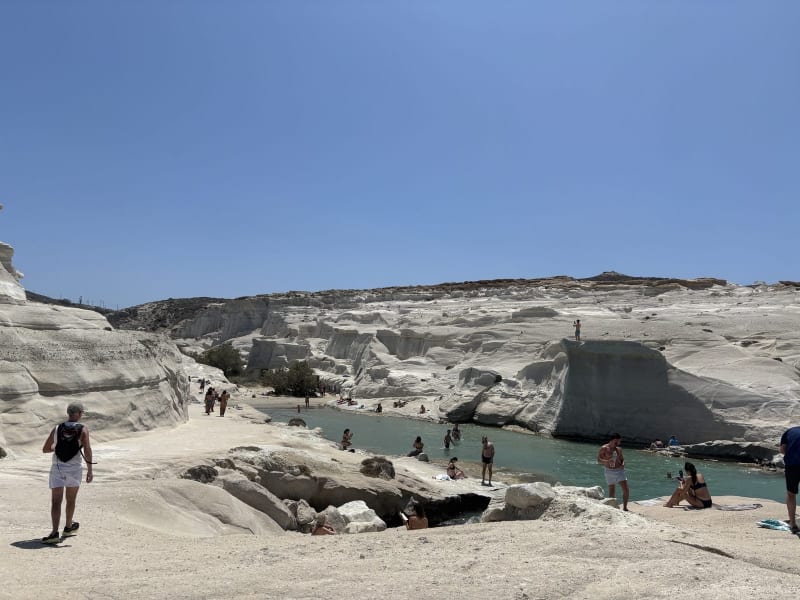
Nothing prepares you for Sarakiniko. You can see photographs. You can read descriptions. You can know intellectually that it's a beach made of white volcanic rock sculpted by wind and waves into something that looks like the surface of another planet. None of it prepares you for standing on it.
The white formations at Sarakiniko are composed primarily of pumice and volcanic tuff — lightweight porous rock formed when frothy lava cools rapidly and traps gas bubbles inside. Wind-driven waves, particularly from the north, have been carving these formations for millions of years, smoothing the pumice into curves and channels and shallow pools that glow white in the Aegean sun. The contrast with the water — which runs from pale turquoise in the shallows to a deep, dark blue at the horizon — is genuinely disorienting. It looks like a film set.

The name derives from the Saracen pirates who once used the protected coves as a hideout — the natural caves and rock overhangs gave them exactly the kind of shelter a pirate needs. Today the shelter is used by swimmers and cliff jumpers and photographers who arrived at dawn to beat the crowds. Go early if you can. By mid-morning in summer, the bus tours arrive and the white rocks fill up fast.
A few practical notes: there is no natural shade at Sarakiniko — the rock reflects the sun intensely — so bring serious sunscreen and water. The rocks are smooth but not always even; water shoes help. The swimming is excellent in the protected coves, and the cliff jumping ranges from approachable to properly brave depending on which ledge you pick. Jump where other people are jumping and you'll be fine.

Sarakiniko is about five kilometers from Adamas — a fifteen-minute drive. It is the most photographed location on the island and among the most photographed beaches in all of Greece, and it earns it. What does it mean when a place is so strange and beautiful that photographs of it look fake? Milos built that place and put it on its northern coast and dares you to explain it.
Klima and the Fishing Villages
Klima and the Fishing Villages
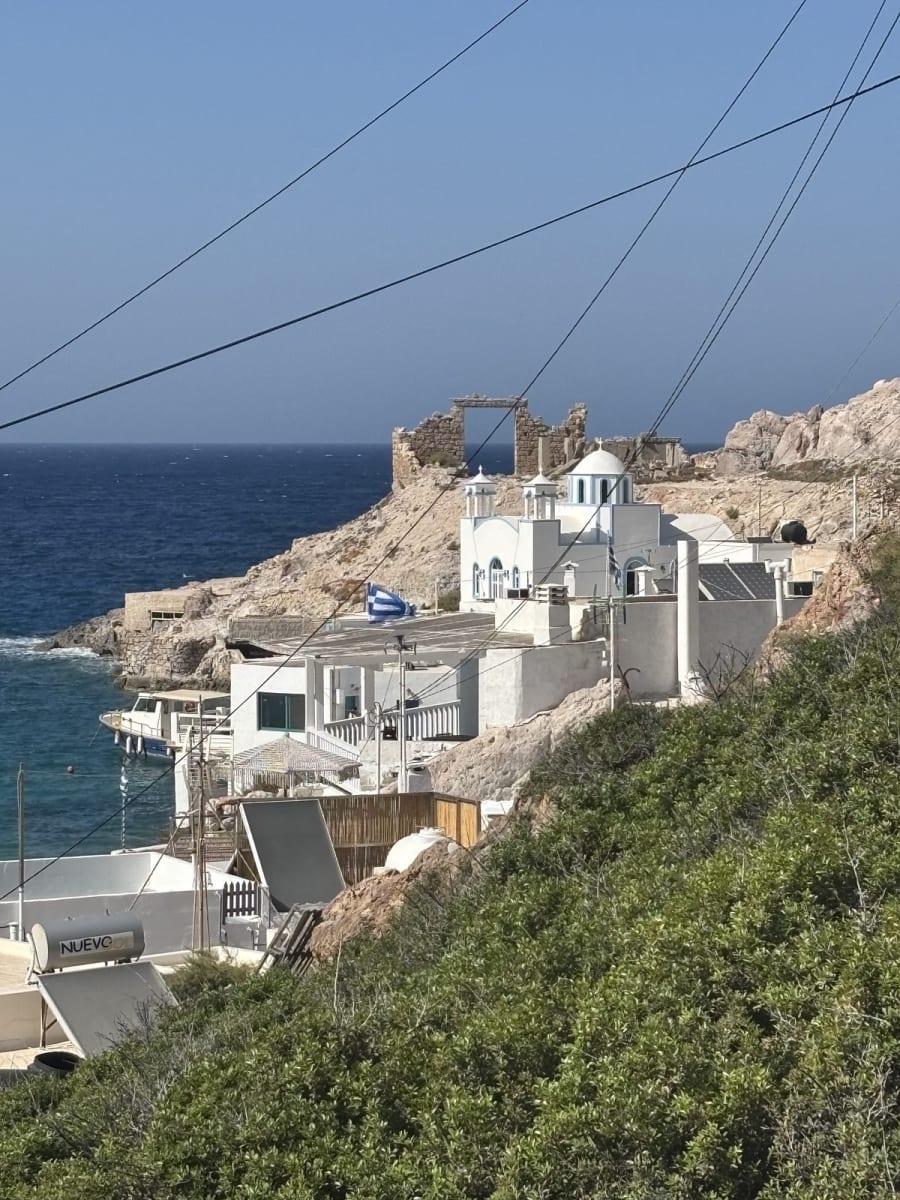
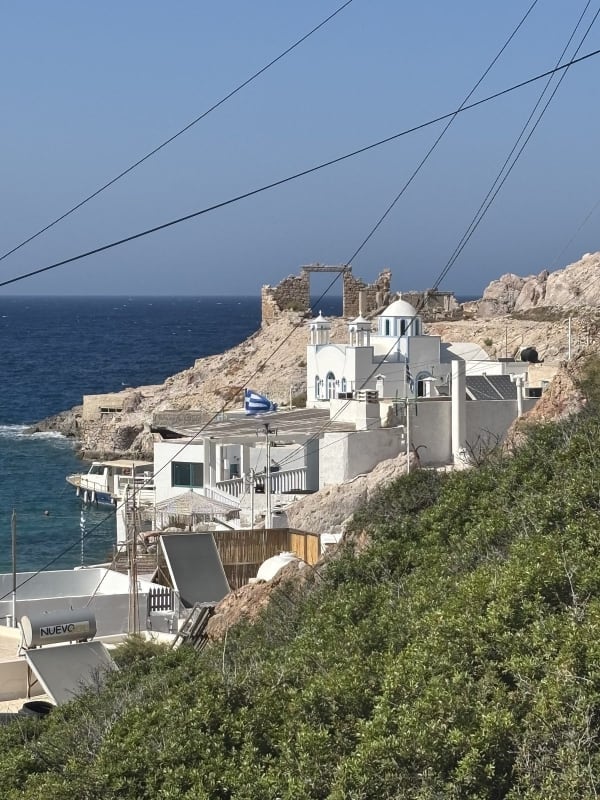
Below the hill town of Trypiti, where the ancient theater and the early Christian catacombs sit overlooking the gulf, the road drops steeply to a handful of houses right at the waterline. This is Klima, and it's unlike anything else in the Cyclades.
The syrmata — the traditional two-story boathouses that define Klima — were built out of pure necessity. Each autumn, when the fishing season ended and the winter winds came in from the north, fishermen needed to drag their boats out of the water and into protected storage. The volcanic tuff of Milos was soft enough to carve, and the coastal caves offered natural starting points. The result: boat garages cut directly into the rock, with living quarters built above. Fishermen painted their doors in the same color as their boats — blue, red, green, yellow — so they could identify their house from the water after a long day out. That practicality became one of the most photographed streetscapes in Greece.
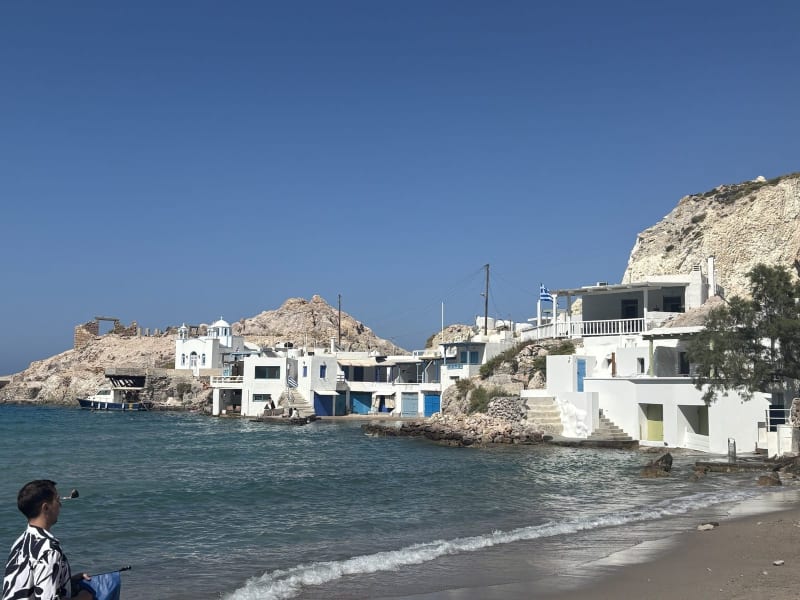
Klima has fewer than 20 permanent residents today. The boat garages that once stored fishing equipment now mostly hold tourists. Some have been converted into small accommodations — staying in a syrmata, with the Aegean literally at your doorstep, is an experience worth seeking out if you can book far enough in advance. The only restaurant in the village is Astakas, right on the water, and it's worth the trip on its own.
Above Klima, near the site of the ancient theater, is also where the Venus de Milo was unearthed by a farmer in 1820. The statue — believed to depict Aphrodite, crafted somewhere between 130 and 100 BCE — now lives permanently in the Louvre in Paris. The discovery site is a short walk from a replica statue at the trailhead. It's quietly moving to stand near where something that famous came out of the ground.
The Beaches
The Beaches
Milos has more than 70 beaches. This is not a list you can finish in a week. What you can do is pick a stretch of water and commit to it for a few hours, and whatever you chose will probably have been worth it.
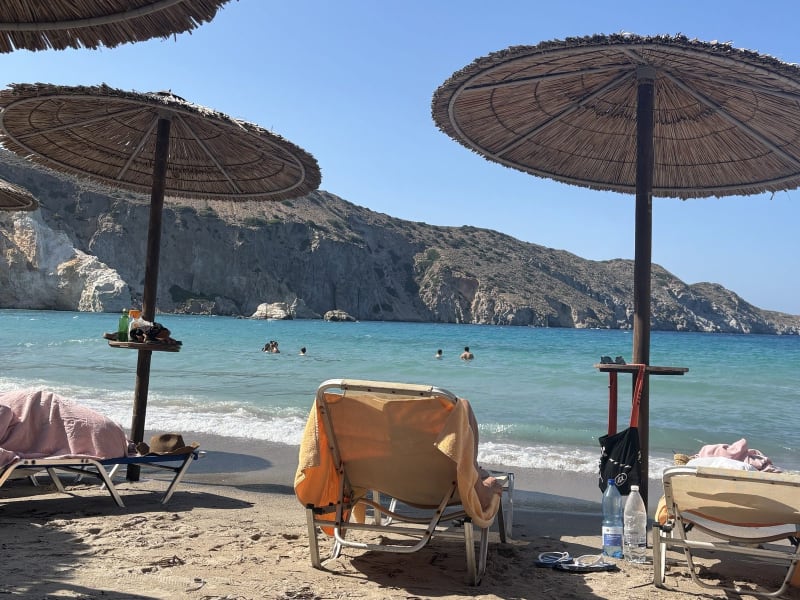
The beach at Agia Kyriaki — where we spent time under thatched umbrellas watching the cliffs — has that quality particular to Milos beaches where the water changes color as you look at it. Pale green at the shore. Deep turquoise in the middle. Dark blue at the horizon. The cliffs behind give it a contained, amphitheater quality that makes the whole bay feel private even when it isn't.
What makes Milos beaches different from much of Greece is the geology directly underneath them. The island's volcanic origins — part of the South Aegean Volcanic Arc formed by the subduction of the African plate beneath the Eurasian plate — produced not just the white formations at Sarakiniko but the colored sands at Firiplaka and Tsigrado (red, yellow, orange from mineral deposits), the geothermally heated waters at Paliochori, and the dramatic cliff formations at beaches all over the island. At Paliochori, some restaurants use the geothermal activity to cook food buried in the sand — a trick that connects dining directly to the volcano underneath your feet.
The beach bar culture on Milos is exactly what it should be: thatched umbrellas, cold drinks appearing without urgency, the sea right there. The bar we found at our first beach had bottles lined up along a wooden counter and a mountain behind it and the Aegean in front and not much else needed.
What beach would you return to before you left? That's the real question Milos asks. Most people can't answer it.
Eating in Pollonia
Eating in Pollonia
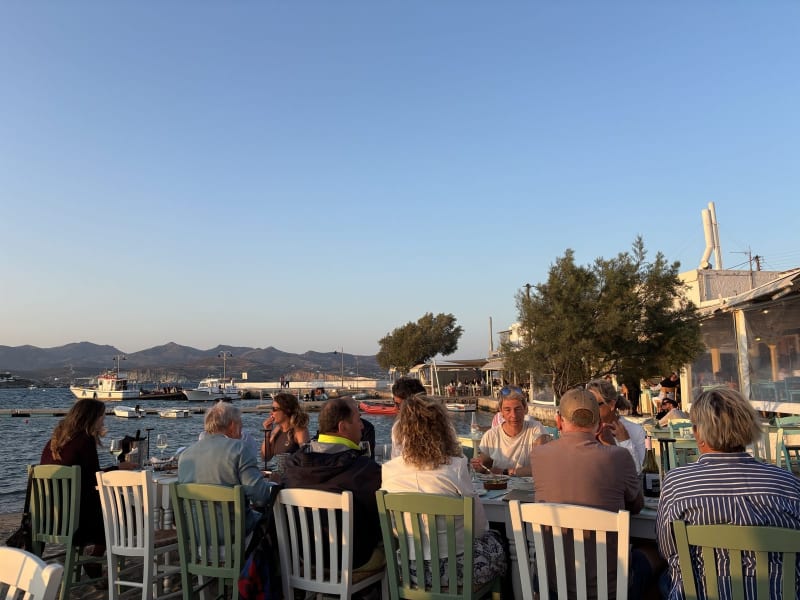
There is a row of whitewashed buildings along the beach in Pollonia that doesn't look like much from the outside. Then your food arrives and you're sitting at a table a few feet from the water, fishing boats bobbing at the dock in front of you, and the whole bay turning gold in the evening light. You stop trying to explain it.

That's the thing about eating in Pollonia. The restaurants sit right at the waterline — modest, unhurried, nothing announcing itself. The food seems to appear from nowhere out of those buildings. It was one of the most romantic meals we've had anywhere, and I say that as someone who has eaten in a lot of places. We were a family of four and everyone was happy. That almost never happens.
The waterfront strip in Pollonia has several strong options. Rifaki is well-regarded for its grilled squid and fresh seafood, with tables close enough to the water that you can hear the boats. Enalion sources largely from the restaurant owner's own farms and is known for locally caught fish. Yialos sits right on the waterfront with views of small fishing vessels and a menu that runs from marinated anchovies to Bluefin tuna tataki. Any of these will do. All of them require a reservation in high season.
A few things worth knowing: wear flip flops. The sand is the floor and you'll want your feet free. Make a reservation — this isn't a secret anymore and the good tables fill up early. Walk the lane after dinner — it looks completely different at night, lanterns lit, the boats on display, the whole village a little quieter and more itself.

What is it about eating with your feet near the sand and the Aegean right there that strips away everything unnecessary? Milos figured that out a long time ago.
The Villages on Foot
The Villages on Foot
Pollonia during the day is a different village than Pollonia at dinner. The cobblestone lane — where Rifaki has a fishing boat in the dining room, where Yialos has outdoor tables in the sun — is easy to walk end to end in ten minutes. The ferry to the neighboring island of Kimolos leaves from here. The harbor has a relaxed quality that makes it easy to lose an afternoon without trying.
Plaka, the hilltop capital, rewards a different kind of wandering. Narrow whitewashed lanes, small churches around every corner, the Venetian castle above everything. The Archaeological Museum houses a plaster cast of the Venus de Milo, and the view from the castle at sunset is one of those experiences that makes the climb feel like the point, not the obstacle.
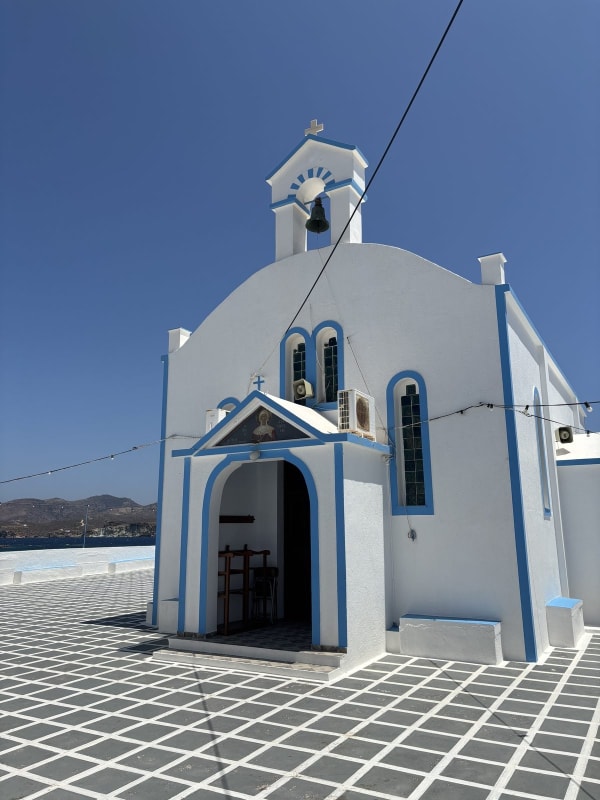
The blue-and-white chapel on the waterfront — standard Cycladic architecture, bell tower, tiled courtyard, sea visible behind it — is the kind of thing you photograph and then realize you've been standing there for twenty minutes. Milos has a lot of those moments. The stop sign on the wall. The whitewashed steps. The view through a doorway that frames the water perfectly.


A useful thing about having a car: you can stop at all of it. Pull over at the overlook above Klima where the ruins sit on the headland and the Greek flag hangs still or snapping in the wind depending on the day. Find the viewpoint where the church and the ancient arch line up against the sea. These things don't announce themselves. They just appear when you're moving slowly enough to see them.
Where to Stay

Where to Stay
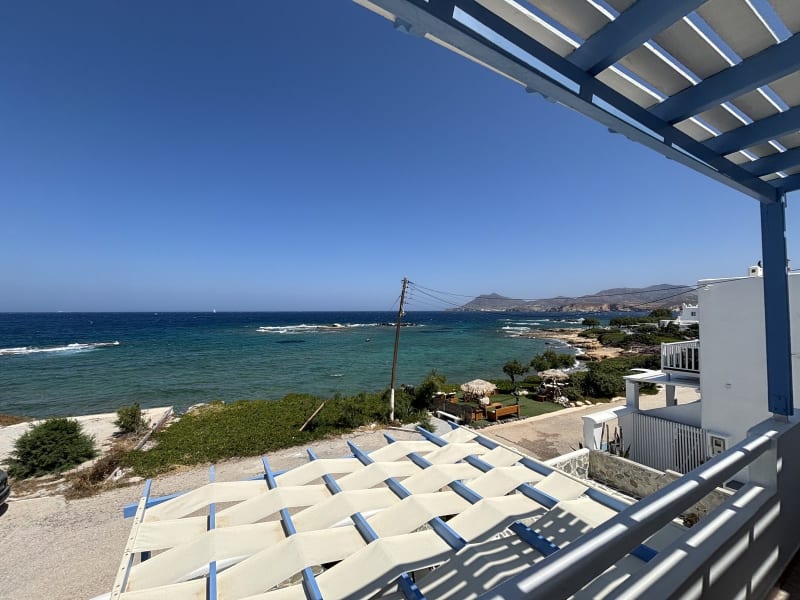
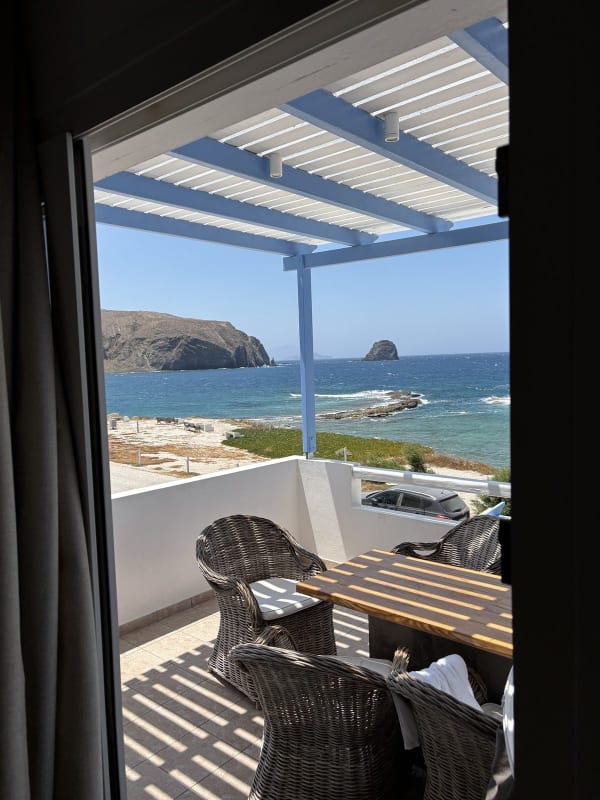
We stayed near Firopotamos on the island's north coast, in a property with a pergola terrace facing the water and a view that made it difficult to leave the room on schedule. The Aegean from a Cycladic terrace at different times of day — morning, midday, the blue hour before sunset, the golden light of early evening — is something that changes every hour and is never quite the same thing twice.

The accommodation options on Milos range from that kind of quieter coastal stay to village rooms in Plaka to the famous syrmata boathouses in Klima. The north coast properties have the best beach access. Staying in Pollonia gives you immediate access to the waterfront restaurants and the ferry to Kimolos. Staying in Plaka gives you sunsets from the castle and proximity to the capital's restaurants and shops.
Whatever you choose: book early. Milos has become popular enough that the good properties fill up well in advance of peak season. July and August are the busiest months — if you want the island with fewer people and similar weather, June and September are the answer.

Sunset on Milos
Sunset on Milos
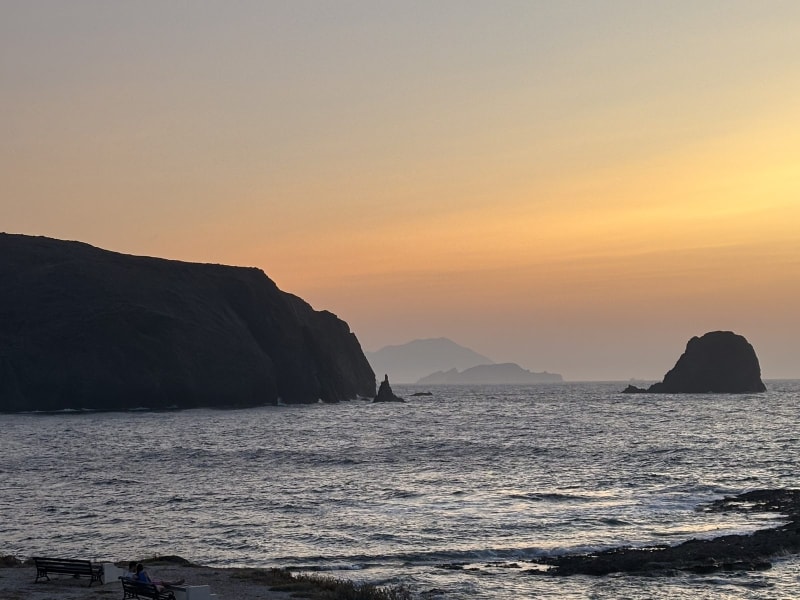
The sunset we watched from the waterfront was not subtle. The cliffs went dark first — silhouettes against a sky that ran orange and gold all the way to the horizon, the sea going from blue to silver to black in the foreground. A couple sat on a bench by the water. Nobody talked much.
Milos doesn't manufacture its sunsets. They happen the way they happen. The wind that made us nervous about flights is the same wind that shapes the rock at Sarakiniko, that keeps the island from getting too comfortable, that reminds you this is the Aegean and not a resort. The island has been exporting minerals and beauty and obsidian for fifteen thousand years. It will continue without your help or mine.

What the island gives you, if you let it, is the particular feeling of having been somewhere real. Not performed for your arrival. Not arranged. A place that was here before tourism and will be here after it, and that tolerates visitors warmly while remaining entirely itself.
What does that feel like, and when did you last find it somewhere? Milos is a good place to find out.
Content ID: usHFu3uRGAvwTt2dkT4A4ysF
See an error? Tell us.


Comments
Share with the Community