

Athens with Teenagers: How the Right Apartment Changes Everything
The Short Version
- The right apartment in Monastiraki puts the Acropolis outside your living room window — and that changes the entire feel of a family trip to Athens.
- Timed entry tickets for the Acropolis are required as of 2024 and sell out; book online before you arrive and go early to beat the crowds and heat.
- The Athens metro (Line 3) runs from the airport to the city center in about 45 minutes for €9 per person — the easiest and cheapest airport transfer for a family of four.
- Monastiraki and Plaka reward wandering: street festivals appear without warning, baklava runs €2.90 a piece, and the taverna portions are genuinely absurd.
- Athens works exceptionally well as a base for Greek island hopping, with ferry connections from Piraeus to dozens of islands — but the city itself deserves more than a transit stop.
- For teenagers, Athens offers something rarer than monuments: a city that has been continuously alive for millennia and doesn't particularly need your approval.
The Apartment

The Apartment
We booked the apartment because of the view. That turned out to be the right reason.
The place was a top-floor flat in the Monastiraki neighborhood — the kind of apartment that opens its entire living room wall onto a rooftop terrace through folding glass doors. When you push them open in the morning, Athens comes inside. And there, every time, framed perfectly above the rooftops: the Acropolis.
Staying in an apartment with teenagers changes the dynamic of a trip. There's space to decompress after a long day of walking. There's a table where four people can eat without restaurant math. There's a terrace where you can sit with a glass of wine at golden hour while the Parthenon turns amber in the fading light — and nobody's rushing you out for the next seating.
"The apartment wasn't just where we slept. It was the part of the trip we kept coming back to."
Athens has strict building height laws that require most of the city to maintain sightlines to the Acropolis. The result is that a well-positioned rooftop in Monastiraki or Plaka can offer an unobstructed view of one of the most recognized structures in human history — from your own private terrace. That's not a hotel amenity. That's a different kind of trip entirely.

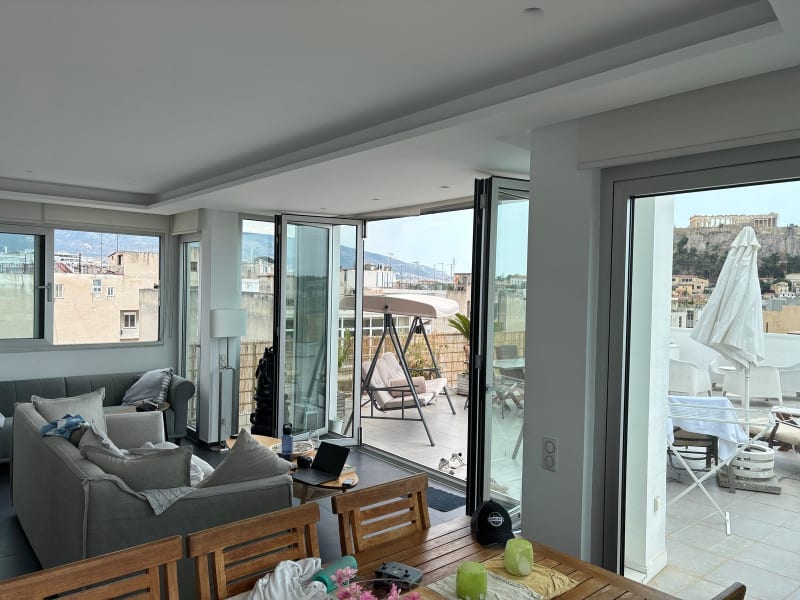
What does it do to a family when the landmark you came to see is also the thing you wake up to every morning?
The Acropolis

The Acropolis
You have to go. That's not optional. But how you go matters.
Timed entry tickets are required as of 2024 — book online before you arrive. An adult ticket runs €20 in high season. The crowds peak between 10am and 3pm, so go early or go late. The site sits at 157 meters above sea level, fully exposed, with almost no shade at the top. Bring water, wear real shoes, and don't underestimate the climb.
None of that preparation fully prepares you for standing in front of the Parthenon.
The temple was built in the 5th century BCE under Pericles, dedicated to Athena, the city's patron goddess. It has survived wars, earthquakes, an accidental explosion in 1687, and centuries of looting. The ongoing restoration scaffolding you'll see isn't a disappointment — it's evidence that people are still fighting to preserve something 2,500 years old. That's worth explaining to your teenagers before you go.
From the top, the view of Athens stretches to the mountains in every direction. The city doesn't end — it just keeps going until it hits the horizon. Standing up there with your kids and looking out over four million people living their lives beneath a monument that old does something to your sense of scale that no photograph quite captures.
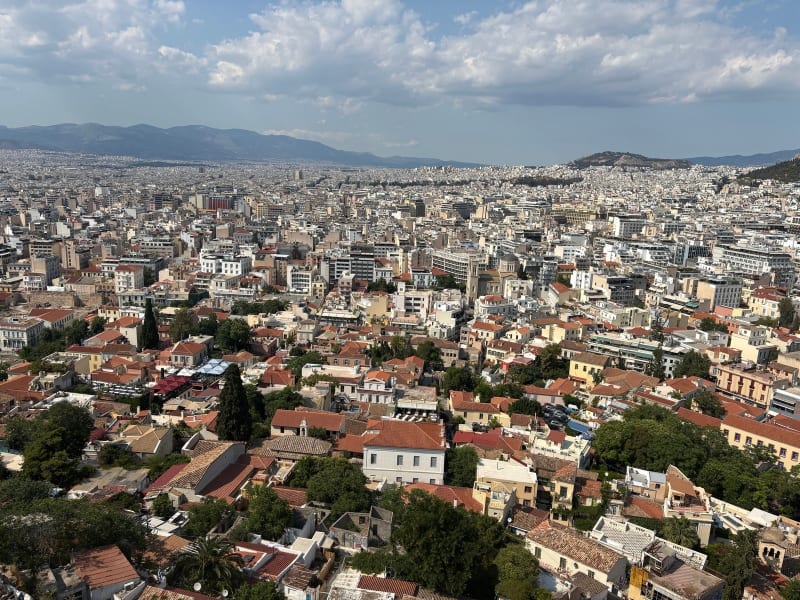
What does it mean to stand somewhere that has been continuously significant to human civilization for over two millennia? That's the question the Acropolis puts in front of you. There's no clean answer. That's the point.
The Neighborhoods

The Neighborhoods
Monastiraki and Plaka are the neighborhoods most visitors spend their time in — and for good reason. They're dense, walkable, and endlessly interesting. The streets are lined with cafés, market stalls, souvenir shops, outdoor restaurants, and the occasional fish pedicure parlor with a sign reading for once, you're the fish food.

One afternoon we turned a corner and walked into what appeared to be a full street festival — a concert stage rigged across an entire block, speakers stacked to the roofline, and a crowd stretching as far as we could see. Athens does this. The city has a way of handing you things you didn't plan for.
The This is Athens City Festival runs throughout May each year, with over 200 free events spread across the city — concerts, markets, rooftop performances, and neighborhood celebrations. Monastiraki Square itself becomes a DJ stage at sunset. If you're visiting in May, expect to stumble into something good.

The Plaka market streets are exactly what you'd expect — and somehow still worth an hour of wandering. The café scene operates at full capacity from mid-morning until late at night. White iron chairs, tables under big trees, waiters moving fast. It's a good place to stop, order something cold, and watch the city work.
What would it take to slow down enough to actually belong to a neighborhood like this, even for a few days?
The Food

The Food
Greek food doesn't need much explanation. It delivers. But a few specific notes from this trip.
Baklava in the pastry shops near Monastiraki runs about €2.90 a piece — honey-soaked, pistachio-dusted, and the kind of thing that requires restraint you almost certainly won't exercise. The souvlaki is fast, cheap, and good enough to eat multiple times. The taverna dinners are generous to the point of absurdity — plates arrive in waves, portions are enormous, and the house wine is fine and inexpensive.

One of the better meals of the trip was takeout eaten on the rooftop terrace while the sun went down over Athens. No reservation required. Just food, the city spread out below, and that view. Some meals earn their place in a trip through the setting alone.

For a proper sit-down dinner, the tavernas in Plaka and Monastiraki are the move — find one that's clearly feeding locals as well as tourists, sit outside, and order more than you think you need.
Getting Around

Getting Around
Athens is more walkable than its reputation suggests, at least in the historic center. Most of what you want to see — the Acropolis, Monastiraki, Plaka, Hadrian's Arch, the Ancient Agora — is within reasonable walking distance if you're staying centrally.
For the airport, skip the taxi. Metro Line 3 (the Blue Line) connects Athens International Airport directly to Syntagma and Monastiraki stations in about 40 to 45 minutes. A one-way ticket is €9 per adult. The train runs every 30 minutes from 6:30am to 11:30pm. For a family of four it's clean, easy, and costs a fraction of a cab. We took it both ways.

The metro within the city is useful for longer distances, but in the historic center you'll mostly be on foot. Comfortable shoes are not optional — the cobblestones in Plaka and the marble paths on the Acropolis demand them.
Hadrian's Arch sits at a busy intersection near the Temple of Olympian Zeus — a 2nd century Roman triumphal gate standing in the middle of modern Athens traffic. It's one of many moments in this city where ancient history simply sits alongside present-day life, unremarked upon by the locals who walk past it every day.
Athens as a Base

Athens as a Base
We came to Athens as part of a longer trip through Greece — the islands came after. That's worth naming, because Athens functions exceptionally well as a base for island hopping. The port at Piraeus is one of the busiest in the Mediterranean, with ferry connections to dozens of Greek islands. Traveloma has covered Milos and Naxos in depth — both were part of this same trip.
But Athens deserves more than the transit stop treatment many travelers give it. A few days in the right apartment, in the right neighborhood, with a rooftop that looks out at the Parthenon — that's not a layover. That's a destination.

The Plaka market streets are worth a slow afternoon. The neighborhoods reward wandering. The food is consistently good and genuinely inexpensive. The history is everywhere, at street level, not roped off behind glass.
For teenagers especially, Athens offers something harder to find than ancient monuments: a living city that takes itself seriously, moves at its own pace, and doesn't particularly care whether you're impressed or not. That indifference is part of the charm. The city has been here for thousands of years. It'll be here after you leave.

Come find out what's waiting when you push those glass doors open in the morning.
Content ID: R0NbqHG55bAt9jyiU4wXpohx
See an error? Tell us.



Comments
Share with the Community