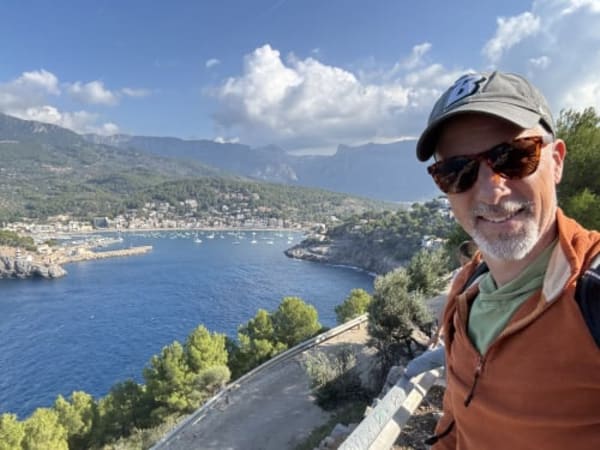

Mount Zeus Naxos: Hiking Mount Zas, the Cave, and the Highest Peak in the Cyclades
The Short Version
- Mount Zeus — also called Mount Zas — is the highest peak in the Cyclades at 1,003 meters, and the hike is harder than it looks on paper.
- Zas Cave, halfway up the trail, was occupied from the Neolithic through the Roman era; the oldest gold object ever found in the Cyclades came from inside it.
- The village of Filoti at the mountain's base and the Vallindras Kitron distillery in Halki — operating since 1896 — are both worth a stop before the climb.
- Kitron, Naxos's citron liqueur, carries a European Protected Designation of Origin and is almost impossible to find off the island due to a decline in citron trees.
- The summit offers a 360° view of Naxos, the surrounding Cyclades, and on a clear day, the faint silhouette of Santorini on the horizon.
- The day ends where it should — at a waterfront table in Naxos Town, with a meal that tastes considerably better after 1,000 meters of vertical.
Lunch First, Mountain Later
Lunch First, Mountain Later
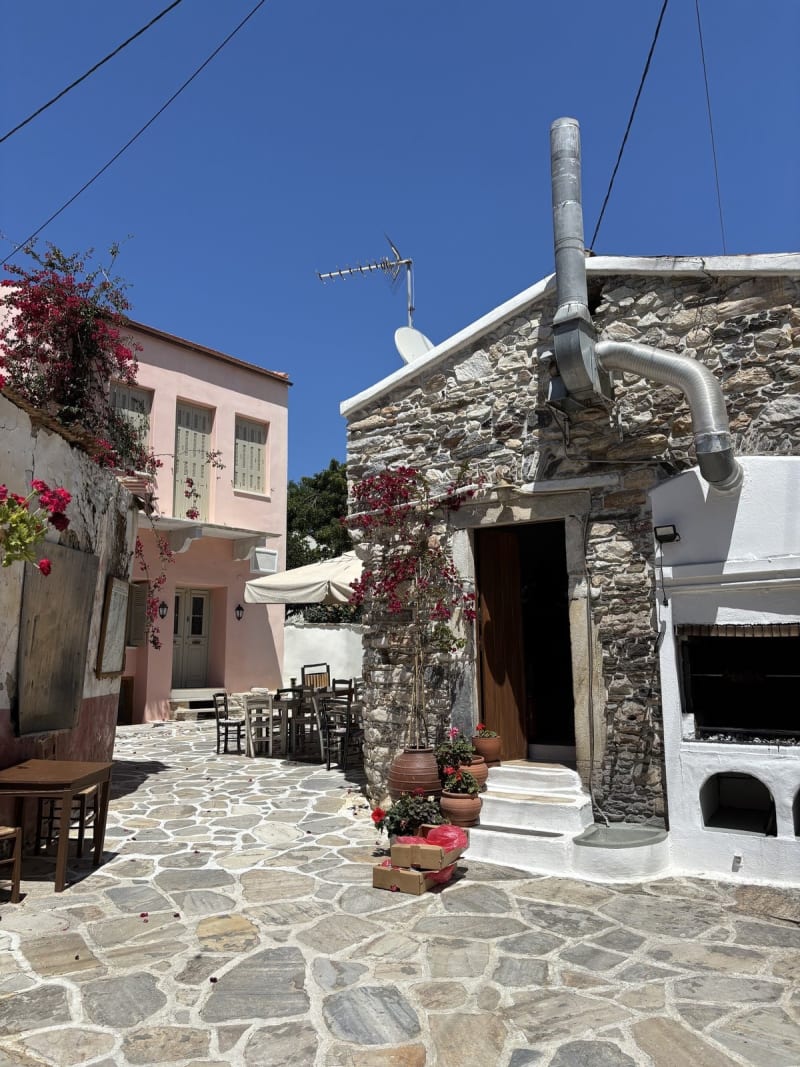
The plan was simple: drive into the mountains, eat something, and then climb the highest peak in the Cyclades. What nobody said out loud, standing in a mountain village square eating tiropita from paper wrappers, was how much mountain there actually was.
Filoti sits at 400 meters — already well above the coast — built amphitheatrically across two hills at the base of Mount Zas. It is the largest village on Naxos, and it feels like a place that has been feeding hikers and shepherds for a very long time. The square is shaded by a plane tree that has been growing there since 1912. The pastries were warm. The marble table was cool. Nobody was in a hurry.
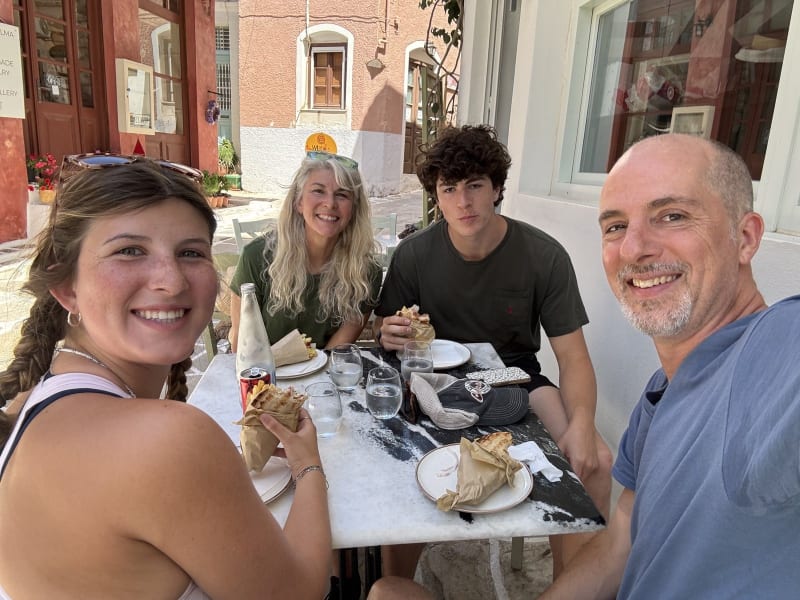
The alleys off the square were worth a quick wander — silver jewelry, handmade souvenirs, a kafeneion that looked like it hadn't changed since the 1970s. Filoti doesn't perform for tourists. It just goes about its business, which happens to include about 60,000 sheep grazing on the surrounding hillsides.

We had water, snacks, and the kind of confidence that comes from not yet knowing what you've signed up for. Time to go find Zeus.
A Quick Stop at the Kitron Showroom in Halki
A Quick Stop at the Kitron Showroom in Halki
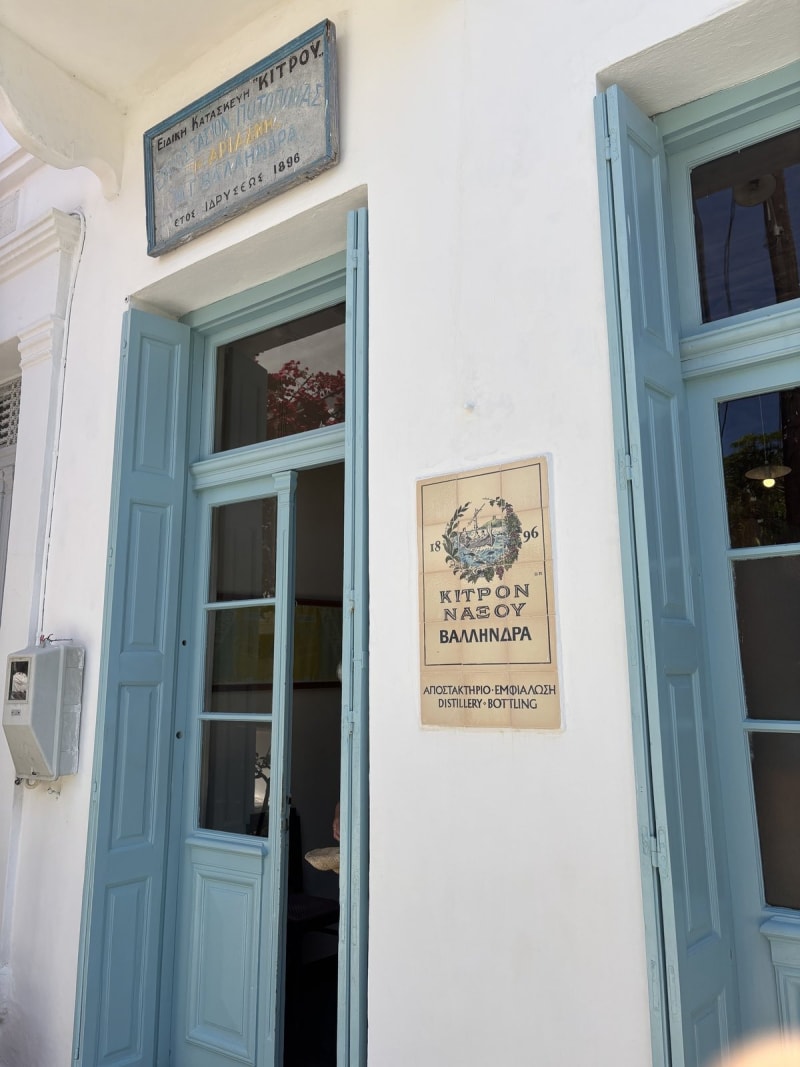
On the way through Halki — the former capital of Naxos — we pulled over for what was supposed to be five minutes. The Vallindras Kitron distillery has been producing Naxos's signature citron liqueur from the same building since 1896, now run by the fifth generation of the same family. We didn't do the full tour — just the showroom — but the copper stills visible through the back of the building made it clear this was the real thing.

Kitron is made from the leaves of the citron tree — citrus medica — which has been cultivated on Naxos since the 17th century. It comes in three varieties: green (sweeter, 30% ABV), white (the locals' preference, 33%), and yellow (strongest, 36%, no sugar). It carries a European Protected Designation of Origin, meaning no one else can legally call their product Kitron. Today very little leaves the island, because the number of citron trees has declined. If you want it, you have to come here.
The free tasting is genuinely worth the stop. The yellow hit like something your grandfather would have approved of.
The Trail Begins

The Trail Begins
The trailhead for the Mount Zeus hike starts at Aria Spring, a natural spring a few minutes' drive past Filoti. The stats on paper sound reasonable: about 5–6 kilometers round trip, 500 meters of elevation gain, rated hard, estimated 4–4.5 hours. The first section is well-marked and well-paved — ancient stone paths that shepherds have used for centuries, with red blazes and small metal markers pointing the way.
The mountain doesn't waste time. The trail climbs immediately through low scrub — thyme, thistle, broom — with the marble peak of Zas visible the whole time above you, looking closer than it is. The sky was the deep flat blue that only exists in the Aegean in summer. It was already hot.
Trail signs along the lower section describe the wildlife you might encounter: Erhard's Wall Lizard, Kotschy's Gecko, and the Nose-horned Viper, which colonized the Aegean 9 million years ago and apparently still lives somewhere up here. We did not see any vipers. I am choosing to feel good about that.
Zas Cave: Where Zeus Grew Up

Zas Cave: Where Zeus Grew Up
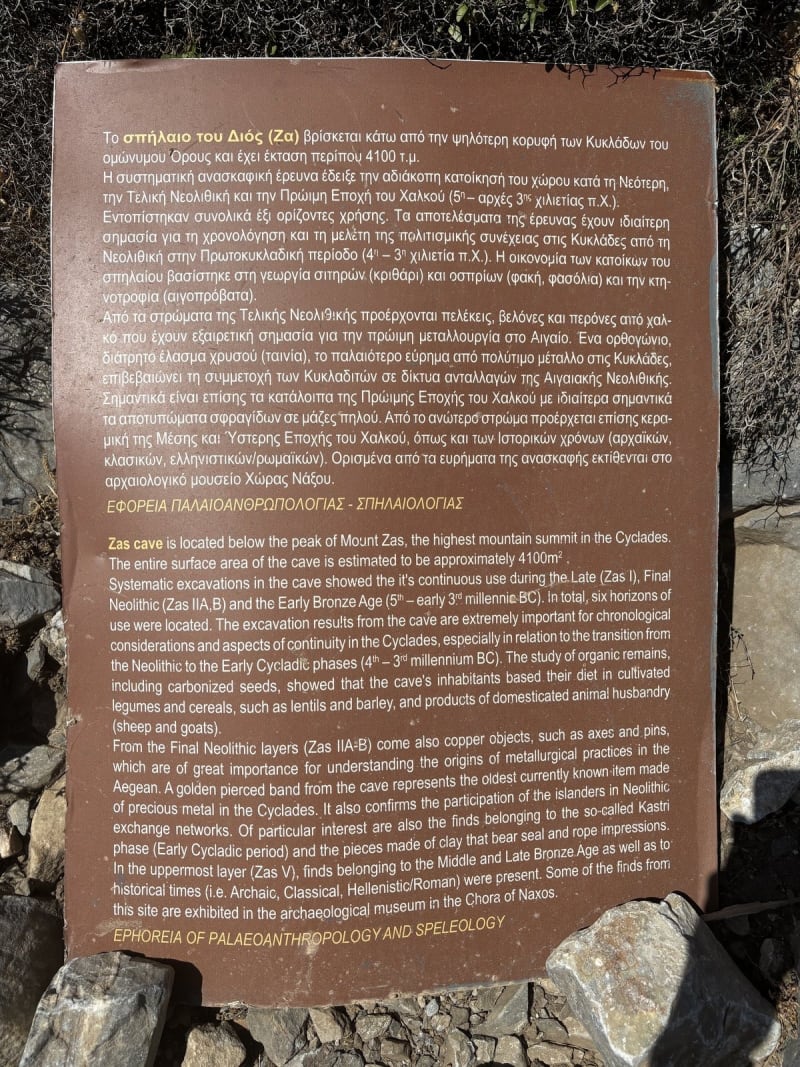
About 20 minutes up the trail, just past Aria Spring, the cave entrance appears on the right — a narrow rectangular gap in the rock face that looks almost constructed, not natural. According to Greek mythology, this is where Zeus was hidden as a child. His mother Rhea had tricked his father Cronus — who had a habit of swallowing his children — by wrapping a stone in cloth and handing it over instead. Zeus was brought here to grow up in secret. Later, at the summit above, an eagle gave him the thunderbolt.
The cave goes about 11 meters deep. Inside, the ceiling drops low and the light disappears almost immediately. The air is noticeably cooler. It feels old in a way that's hard to put into words — which makes sense, because it is. Excavations in 1985–86 and 1994 found artifacts spanning from the Neolithic period through the Roman era. The oldest gold object ever found in the Cyclades came from this cave. Some of those finds are now on display at the Archaeological Museum in Naxos Town.


The cave entrance has graffiti scratched into the walls. People have always felt compelled to leave their mark here. It doesn't feel like vandalism, exactly — more like a very long tradition of people saying I was here in the same place where humans have been saying it for 7,000 years.
The Summit Push

The Summit Push
Above the cave, the trail changes character. The stone paving disappears. The vegetation thins out. What replaces it is loose white marble rock — Naxos is one of the world's great sources of marble — stretching up toward a summit that still looks improbably far away.
The trail is marked with red dots and cairns, but you have to pay attention. The wind picks up. The scrub gives way to open rocky terrain. There is no shade.

A purple thistle with a yellow butterfly landed right in front of us on the way up. The mountain has its own pace, and it is not yours. We stopped and looked at it for a while.

The ridge section is where the views start becoming something else entirely. the whole island opens up below — terraced hillsides, white villages in the distance, the Aegean on both sides. A narrow path with a wire fence is the only thing between you and a very long drop. We moved carefully and didn't stop long.
We came around a boulder and found ourselves face to face with the most unbothered sheep I've ever encountered — wool down to its knees, grazing at what felt like 900 meters, completely indifferent to the altitude, the heat, or the three sweating humans who had just interrupted its morning.

The Top of the Cyclades
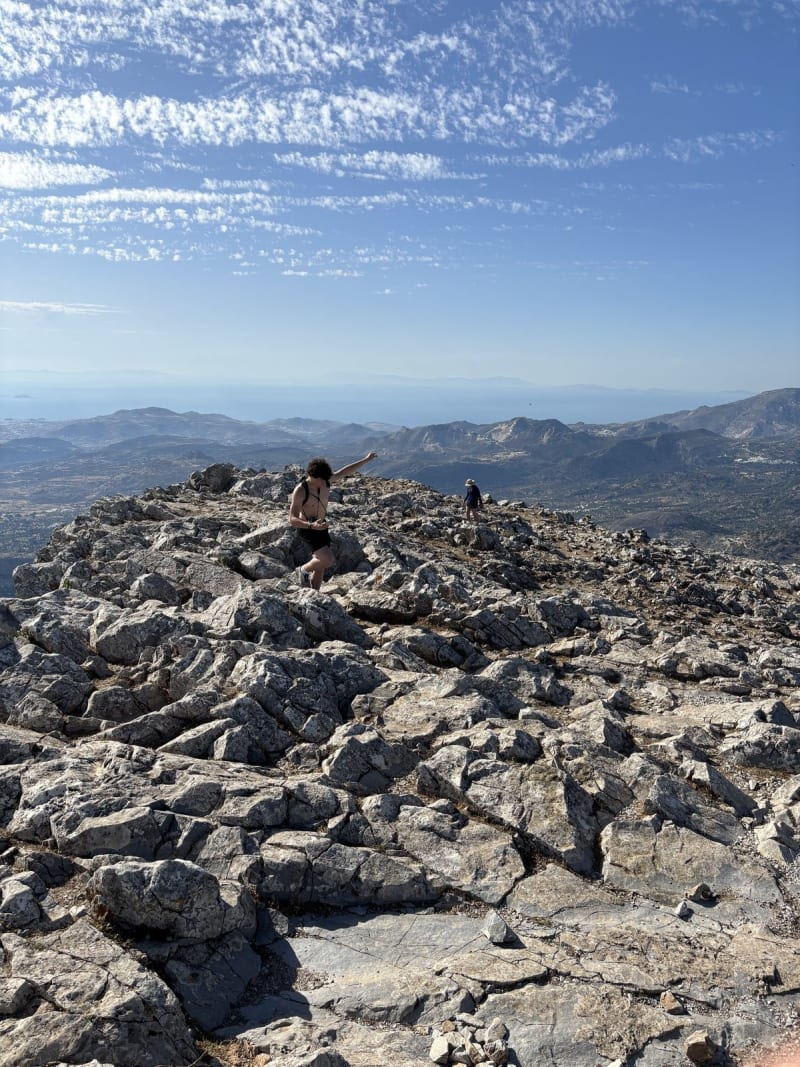
The Top of the Cyclades
Mount Zas tops out at 1,003 meters — 3,290 feet — the highest point in the entire Cyclades archipelago. Standing on top, that fact becomes physical rather than abstract. The island spreads out in every direction below you. Chora is visible on the coast. The white cube of every village we'd driven through that morning is somewhere in the landscape. On a clear day you can see Paros, Ios, and the faint outline of Santorini on the horizon.
The summit is wide, rocky, and windy. There's no dramatic marker or cairn — just the highest point, and then the world falling away in every direction. We stayed longer than planned. Nobody said much.

"At the top of this mountain, according to legend, an eagle gave Zeus the thunderbolt. Standing up here, watching the Aegean stretch to the horizon, it is not hard to understand why the ancients put their gods here."
The Way Down
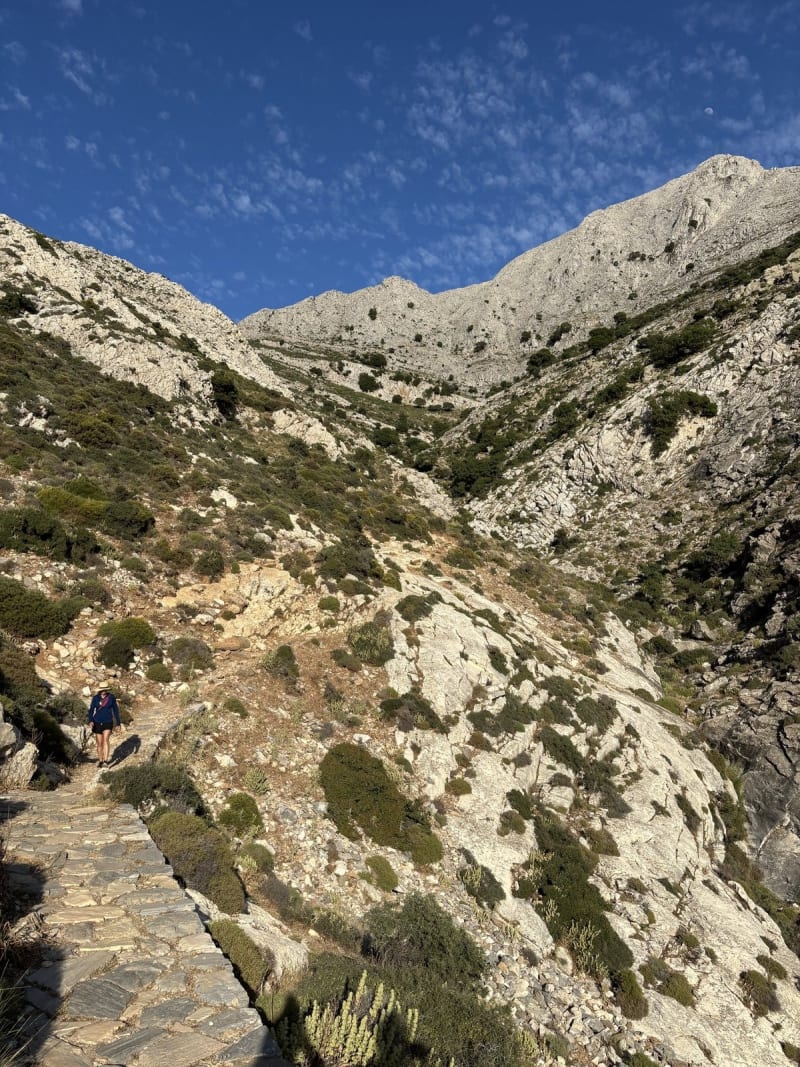
The Way Down
The descent on the ancient stone path is where the day earns its full meaning. The morning's urgency — get to the top, keep moving — dissolves. the views on the way down are somehow better than on the way up, maybe because you're no longer rationing your energy for what's above you.

The stone paving on the lower trail is extraordinary — thousands of years of careful fitting, still holding. One person walking ahead, mountains above, the moon already risen in the afternoon sky. The kind of moment that doesn't need commentary.

The round trip took us the better part of four hours. By the time we reached the car the legs were done, the water was gone, and the general consensus was that this had been the right choice.
Dinner in Naxos Town

Dinner in Naxos Town
There is a particular quality to dinner after a day like this. Everything tastes better. The fish is fresh and the salad is sharp and the table feels earned in a way that most tables don't. We sat at a restaurant on the Naxos Town waterfront, the harbor behind us, the whole day behind us, and just ate.
The mountain was still up there somewhere in the dark, doing whatever mountains do when no one is on them. We had been up there. That felt like enough.
What does it mean to climb the mountain a god supposedly called home? Probably nothing, in any literal sense. But the Cyclades have a way of making the mythological feel almost plausible — the light, the stone, the scale of the Aegean. Standing on top of Mount Zeus, looking out at islands that human beings have been living on for thousands of years, the mythology starts to feel less like a story and more like an attempt to describe something real.
Content ID: cYd4hECyc1uQaJIGdPH5bwJt
See an error? Tell us.

Comments
Share with the Community